






The insightful articles, inspiring narrations and analytical perspectives presented by the Editorial Team, establish an alluring connect with the reader. My compliments and best wishes to SP Guide Publications.

"Over the past 60 years, the growth of SP Guide Publications has mirrored the rising stature of Indian Navy. Its well-researched and informative magazines on Defence and Aerospace sector have served to shape an educated opinion of our military personnel, policy makers and the public alike. I wish SP's Publication team continued success, fair winds and following seas in all future endeavour!"

Since, its inception in 1964, SP Guide Publications has consistently demonstrated commitment to high-quality journalism in the aerospace and defence sectors, earning a well-deserved reputation as Asia's largest media house in this domain. I wish SP Guide Publications continued success in its pursuit of excellence.
Matangi marks a milestone in India's autonomous maritime capabilities, combining indigenous AI, navigation and collision-avoidance technologies. With the Army and Navy acquiring these unmanned vessels, Matangi could strengthen coastal surveillance, border security and future naval operations.
 |
The Author is Former Director General of Information Systems and A Special Forces Veteran, Indian Army |
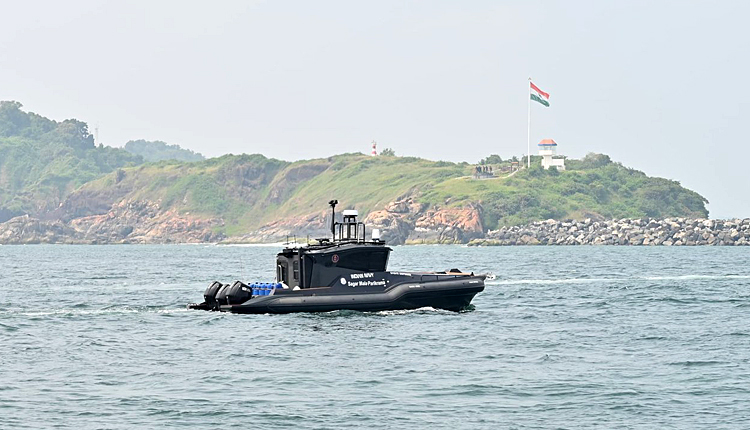
Pune-headquartered Sagar Defence Engineering has developed 'Matangi' - India's first Autonomous Surface Vessel (USV). The vessel made history by completing an incredible 1,500-km (850 nautical miles) sea journey from Mumbai to Thoothukudi (Tuticorin) in Tamil Nadu without a single crew member on board. Capable of operating with or without a crew, Matangi is equipped with advanced navigation and collision-avoidance software. In its initial phase, Matangi travelled 600-km from Mumbai to Karwar autonomously, followed by another 1,000-km stretch to Thoothukudi, marking a new milestone in India's maritime technology.
The historic voyage was called the "Sagarmala Parikrama". Defence Minister Rajnath Singh flagged it off under the Indian Navy's 'Swavlamban' initiative. The vessel is driven by a homegrown Artificial Intelligence (AI) system named 'Genesis'. It uses special Indian-made navigation and collision-avoidance software to steer safely through the ocean. Matangi can self-right (flip itself back over) if it capsizes. It can also withstand giant waves up to six meters high. India's security forces are acquiring these weaponised boats. Outfitted with a 12.7 mm Stabilized Remote-Controlled Gun (SRCG) to neutralise threats autonomously or via remote operator override, they can also carry loitering munitions and short-range missiles. They feature dual cameras, radar tracking, and can operate for 48 hours straight using ISRO's NaVIC navigation system, although NaVIC needs to be urgently replaced or revived. But Matangi can even navigate in electronic warfare (EW) zones where GPS is blocked.
The vessel made history by completing an incredible 1,500-km (850 nautical miles) sea journey from Mumbai to Thoothukudi (Tuticorin) in Tamil Nadu without a single crew member on board
The Matangi, 13-metre-long unmanned fast interceptor crafts (FICs) are capable of sustained speeds exceeding 50 knots with an operational endurance of 48 to 72 hours. The Indian Armed Forces are deploying the Matangi Autonomous Surface Vessel (USV) to act as unmanned "eyes, ears, and weapons" in highly sensitive areas. The Indian Navy is acquiring 10 of these vessels, while the Indian Army is getting 2, establishing a forward defence network against coastal and border threats. The Indian Navy primarily plans to use the vessels to patrol vast stretches of India's long coastline, protect vital shipping lanes, and shield naval ports:
The vessel is driven by a homegrown Artificial Intelligence (AI) system named 'Genesis'
The Indian Army is deploying its Matangi units to heavily contested, high-altitude border waters as under:
Beyond standard sailing, the Matangi is designed as a mothership for secondary weapons. It can carry and launch Loitering Munitions (suicide drones) directly from its deck, giving both the Army and Navy the capability to strike targets miles away from the vessel itself.
Sagar Defence, officially established in May 2015. It was started by Captain Nikunj Parashar (former Merchant Navy officer) alongside co-founders Mridul Babbar, Lakshay Dang, Saurabh Patil, and Ankit Kumar in a small workplace in Mumbai. What began as a small startup has matured into a prominent Series B company, having raised around $48.2 million in total funding. Sagar Defence focuses entirely on autonomous technology; to manufacture unmanned systems for the air (drones), land (robotic vehicles), and sea (uncrewed boats).
The Indian Navy is acquiring 10 of these vessels, while the Indian Army is getting 2, establishing a forward defence network against coastal and border threats
Sagar Defence presently operates a 10-acre defence manufacturing and R&D campus in Pune, where they recently inaugurated a major plant to build uncrewed sea vehicles in partnership with Boeing's Liquid Robotics. The company has laid the foundation stone for the world's first Autonomous Maritime Shipbuilding and Systems Centre at the Juvvaladinne Fishing Harbour in Andhra Pradesh.
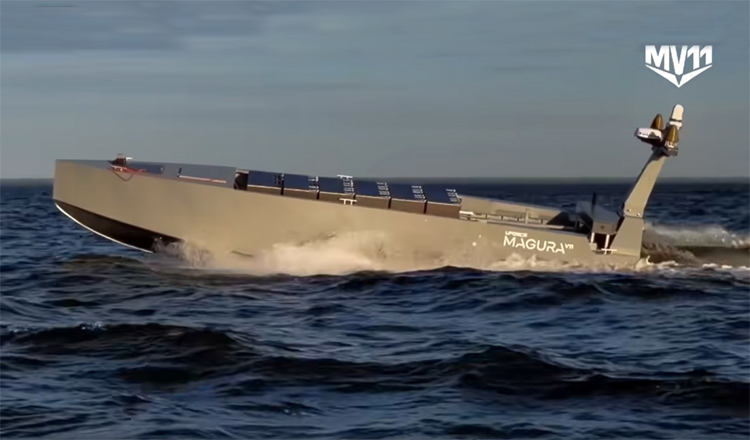
Globally, the case for building easily sinkable and really expensive manned naval warships is diminishing by the day; given that China could build 50,000 USVs of a range of different designs - for the cost of one aircraft carrier. Ukraine's 'Magura MV11' USV is a super-sized mothership packed with anti-drone interceptors designed for days-long open ocean operations. Magura MV11 is designed for open-ocean operations lasting up to a week and can carry payloads weighing up to 2,200 kg (4,850 pounds). The drone boat has so far been shown in one configuration, loaded with 18 small vertically launched 'Sting' interceptors, turning it into a small floating counter-drone battery. Given its significant payload capacity and other capabilities, it could also be utilised in other roles. Sting interceptors are loaded individually in box-like launchers, which can also be employed in other domains, including mounted on trucks or positioned on the ground. Weighing roughly nine pounds, the Sting interceptor is an electrically powered quad-rotor system with a small explosive warhead. It makes heavy use of 3D-printed components, and each one has a reported cost of around $2,100.
Finally, the Matangi project marks a huge step forward for India's self-reliance in high-tech naval defence and autonomous USVs.