






The insightful articles, inspiring narrations and analytical perspectives presented by the Editorial Team, establish an alluring connect with the reader. My compliments and best wishes to SP Guide Publications.

"Over the past 60 years, the growth of SP Guide Publications has mirrored the rising stature of Indian Navy. Its well-researched and informative magazines on Defence and Aerospace sector have served to shape an educated opinion of our military personnel, policy makers and the public alike. I wish SP's Publication team continued success, fair winds and following seas in all future endeavour!"

Since, its inception in 1964, SP Guide Publications has consistently demonstrated commitment to high-quality journalism in the aerospace and defence sectors, earning a well-deserved reputation as Asia's largest media house in this domain. I wish SP Guide Publications continued success in its pursuit of excellence.
Bullet Absorbing Station (BAS) is optimised for rapid-reaction forces, temporary checkpoints, and high-mobility urban warfare requiring quick setup or relocation, while 3D concrete shelters excel in permanent defensive fortifications, long-term border outposts, and deep dugout reinforcement.
 |
The Author is Former Director General of Information Systems and A Special Forces Veteran, Indian Army |
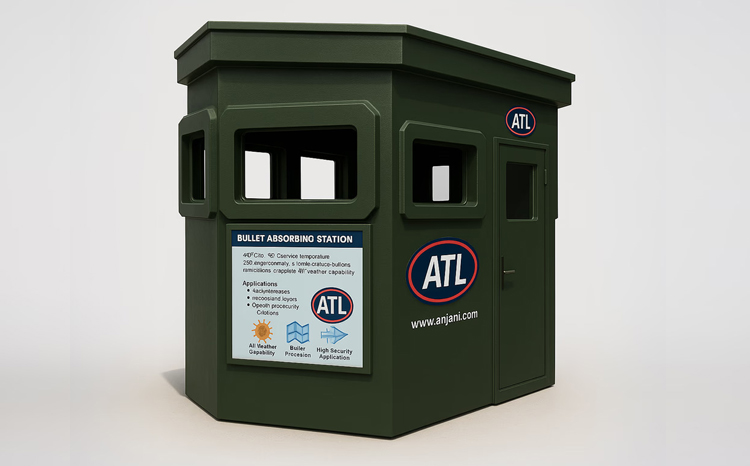
Greater Noida-headquartered advanced materials and defence manufacturing firm Anjani Technoplast Limited (ATL), with its primary manufacturing facility located at Ecotech-1, has developed Bullet Absorbing Station (BAS). Incorporated on February 29, 1988, the company initially launched as a thermoforming unit before transitioning into an advanced precision engineering and defence powerhouse.
Beyond its BAS, the company has developed a diverse product portfolio across defence, aerospace, and industrial sectors, including: bulletproof jackets and helmets; armoured sentry posts; riot control equipment; pressurised missile containers; vehicle armouring panels; CNC waterjet cutting machines; multi-head drilling and deburring equipment; precision engineering components; plastic honeycomb panels; heavy-duty plastic pallets for thermoformed logistic solutions.
BAS utilises lightweight, kinetic-energy-absorbing composite materials for high mobility, whereas 3D-printed structures rely on high-density concrete mass and automated layer-by-layer printing for permanent structural integrity.
ATL has supplied its BAS, also referred to as the Bullet Absorbing BunkerWall, to the Indian Army's Northern and Eastern Commands. Rather than traditional sandbag walls or standard concrete bunkers that risk chipping or ricocheting, BAS are prefabricated, ultra-protective tactical structures designed to catch and nullify hostile fire. Built using aviation-grade composite honeycomb layers, the structure takes the impact, absorbs kinetic energy internally, and completely prevents bullet ricochets or secondary fragment damage.
According to the company, a single square foot of the bunker wall can withstand over 1,500 armour-piercing rounds from AK-47s, Light Machine Guns (LMGs), and Medium Machine Guns (MMGs). It can absorb up to 50,000 AK-103 rounds without structural failure. BAS delivers NIJ Level IV ballistic protection, guarding troops against blast splinters, grenades, mortar fragments, and indirect projectile impacts. The modular components weigh less than 25 kg each. Two soldiers can assemble the entire structure in two hours using a simple 9-step sequence without needing any heavy machinery or power tools. The advanced composite core closes around entry holes to automatically block chemical, biological, or environmental hazards from sneaking into the shelter.
Built with composite honeycomb layers, a single square foot of BAS can absorb over 1,500 armor-piercing rounds or up to 50,000 AK-103 rounds without structural failure, featuring modular panels under 25 kg that two soldiers can manually assemble in two hours without heavy tools.
At the same time the Indian Army started extensively field-testing and deploying 3D-printed structures along border areas in 2022, beginning with prototype trials in Pokhran and inauguration of its first 3D-printed troop housing in Ahmedabad. Trials in Pokhran proved they could withstand direct fire from T-90 main battle tanks. This technology has since scaled to full operational use, with delivery of over 500 blast-resistant bunkers completed by late 2025.
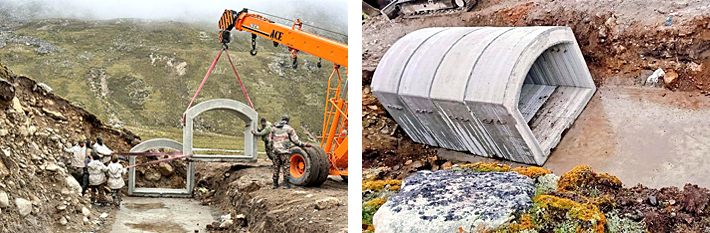
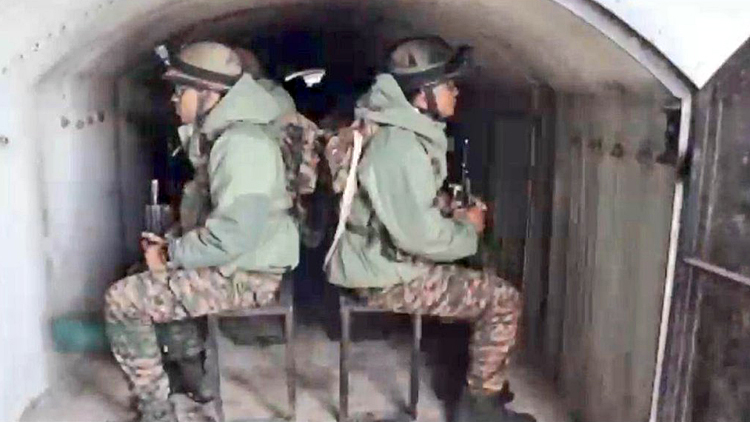
Key suppliers and partners for 3D-printed structures are: Ahmedabad-based deep-tech startup MiCoB Private Limited – delivered over 500 prefabricated structures engineered to survive extreme weather and direct artillery hits; Hyderabad-based Simpliforge Creations – partnering with the military to execute on-site construction; IIT Hyderabad – driving Project PRABAL (Portable Robotic Printer for Printing Bunkers and Accessories) and designed a vehicle-portable robotic arm printer to build bunkers directly in forward operational zones like Ladakh and Sikkim; IIT Gandhinagar & IIT Madras - incubation partners that assisted in structural designs, materials science, and testing alongside the Indian Army's Corps of Engineers.
Operationalised through partnerships with deep-tech startups (like MiCoB) and academic institutes (IITs), 3D concrete printing technology has slashed traditional high-altitude fortification setup times from 45 days down to under a week.
The period 2024-2025 saw on-site extreme altitude deployment of 3D bunkers. The world's first on-site 3D-printed bunker was set up at an altitude of 11,000 feet in Leh, Ladakh, adapting the machinery to function in low-oxygen conditions. This was followed by mass deployment of 3D bunkers during 2025; the technology moving from localised trials to large-scale infrastructure reinforcement. The Indian Army's Trishakti Corps fully operationalised mobile 3D printers in Sikkim and Arunachal Pradesh, dropping standard fortification setup times from 45 days down to less than a week.
BAS supplied by ATL and 3D-printed concrete bunkers represent two entirely different engineering paths to protective military infrastructure. While ATL's shelters rely on high-tech, lightweight composite materials, 3-D shelters rely on automated, layer-by-layer on-site concrete printing. In essence, both represent a fundamental divide in modern protective engineering. BAS explores advanced ballistic science using lightweight composite materials, specialised aramid fibers, and high-performance polymers designed to absorb and dissipate kinetic energy, whereas, 3D-printed bunkers utilise quick-setting, fiber-reinforced concrete formulations deployed layer-by-layer via automated gantry or robotic-arm printers.
Mobility and deployment-wise BAS is highly mobile since prefabricated panels can be rapidly transported and bolted together manually in remote areas, whereas 3D-printed bunkers are logistically heavy, requiring transportation of large robotic printing rigs, mortar mixers and bulk raw material to the site. Construction speed of BAS is near instantaneous once delivered to the forward operating base. Construction of 3D-printing bunkers requires active printing time followed by structural curing phases before full combat deployment; could take hours to days. Protection mechanism of BAS is kinetic energy absorption and fragment containment, reducing spall risks inside the shelter, whereas, 3D-printed bunkers rely on mass on thickness - brute physical density and structural geometry to deflect or withstand heavy ordnance.
The Indian Army has actively operationalised 3D-printed bunkers in volatile and high-altitude border regions including Ladakh, Sikkim, and Arunachal Pradesh, successfully establishing the world's first on-site 3D-printed bunker at 11,000 feet in Leh.
The BAS, developed by ATL, is optimised for rapid-reaction forces, temporary checkpoints, forward observation posts, and high-mobility urban warfare where structures must be erected or relocated in minutes. Concurrently, 3D Concrete Shelters excel in permanent defensive fortifications, border outposts, deep dugout reinforcement, and large-scale habitat construction where long-term structural mass is paramount.
Both systems are actively deployed by the Indian Army to fortify critical, high-risk, and geologically hostile frontiers. BAS is deployed in J&K and Ladakh in Northern Command along volatile forward combat zones and high-security military installations. Its specific design resists intense, close-quarters burst fire from AK-47/103, INSAS, and SLR rifles while operating in extreme sub-zero climates down to -40°C. In Eastern Command, BAS is deployed along sensitive, dense jungle environments and immediate border zones where rapid, man-portable setup is critical to tactical flexibility.
3D-Printed Concrete Bunkers are deployed in Ladakh, Sikkim and Arunachal Pradesh. The Indian Army's Trishakti Corps has operationalised vehicle-mounted 3D concrete printers in forward areas of Sikkim to combat extreme high-altitude terrain challenges. 3D concrete bunkers are deployed extensively in Ladakh and Arunachal Pradesh under Project PRABAL (Portable Robotic Printer for Printing Bunkers and Accessories). Defence startups like MiCoB have collectively manufactured and delivered over 500 blast- and impact-resistant 3D-printed bunkers to replace aging defence infrastructure, slashing traditional 45-day bunker construction timelines down to under 7 days.