




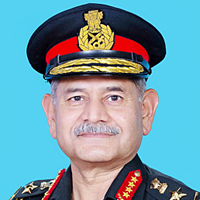
The insightful articles, inspiring narrations and analytical perspectives presented by the Editorial Team, establish an alluring connect with the reader. My compliments and best wishes to SP Guide Publications.
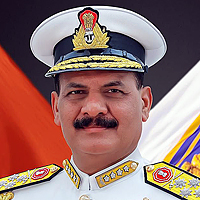
"Over the past 60 years, the growth of SP Guide Publications has mirrored the rising stature of Indian Navy. Its well-researched and informative magazines on Defence and Aerospace sector have served to shape an educated opinion of our military personnel, policy makers and the public alike. I wish SP's Publication team continued success, fair winds and following seas in all future endeavour!"

Since, its inception in 1964, SP Guide Publications has consistently demonstrated commitment to high-quality journalism in the aerospace and defence sectors, earning a well-deserved reputation as Asia's largest media house in this domain. I wish SP Guide Publications continued success in its pursuit of excellence.
China's sustained strategy of asserting territorial claims through renaming places in Arunachal Pradesh and creating new administrative counties near disputed regions are aimed at strengthening Beijing's strategic influence and pressuring India
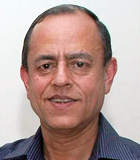 |
The Author is Former Director General of Information Systems and A Special Forces Veteran, Indian Army |
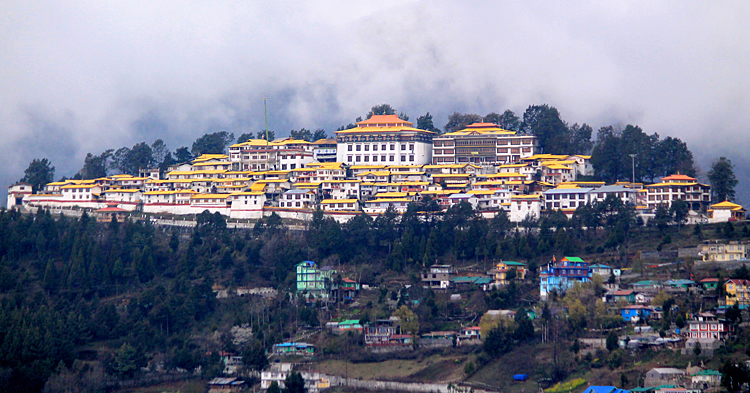
China has been raising irredentist claims on territories and resources of its neighbours on one pretext or another, aimed at eventually grabbing them as Chinese territories. China has been doing so in India's Arunachal Pradesh, as well as in the South China Sea and East China Sea islands. Having initially claimed the Tawang Monastery, China now lays illegal claims to the 90,000 sq km of entire Arunachal Pradesh. China's foreign ministry think tank published an article in 1986 by Jing Hui claiming this region as "more important" for his country. Since 2003, Beijing has been configuring Arunachal Pradesh as "southern Tibet" (Zangnan), defining Tibet as its "core interest" to be defended by its military.
This naming game for creating fictitious claims over Indian territory is a psychological and sub-conventional war tactic seeking to bolster China's "South Tibet" narrative
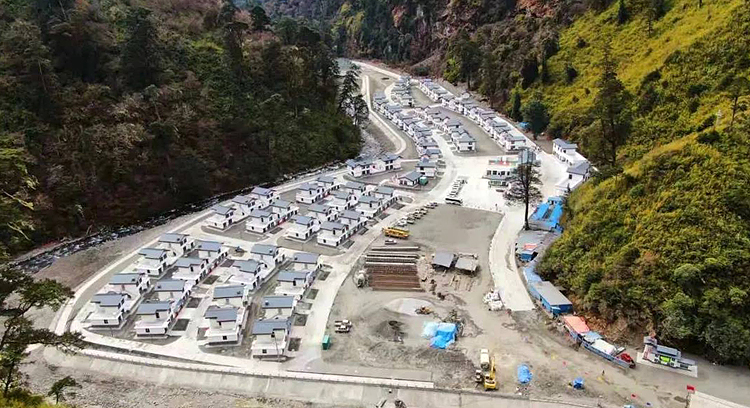
China periodically releases lists of "invented" Chinese names for places in Arunachal Pradesh (five times between 2017 and 2025), claiming them as part of South Tibet. This naming game for creating fictitious claims over Indian territory is a psychological and sub-conventional war tactic seeking to bolster China's "South Tibet" narrative; to provoke India, assert dominance, and shift the Line of Actual Control (LAC) without direct conflict - designed to keep India off-balance, embarrass India internationally, and assert that the entire region is in dispute, not just isolated areas. This renaming is not merely symbolic, but is supported by PLA intrusions, construction of border villages acting as staging points, and structural changes on the ground to slowly alter the LAC.
In 2024, China issued another list of Chinese names for 30 places in Arunachal Pradesh; fourth such list with the first three having being released in 2017, 2021 and 2023 (6 place names on April 18, 2017, 15 on December 29, 2021, 11 and April 2, 2023). Beijing issued the fourth list of 30 places on March 30, 2024 after Prime Minister Narendra Modi dedicated the Sela Tunnel to the nation virtually from Itanagar on March 9, 2024.
This renaming is not merely symbolic, but is supported by PLA intrusions, construction of border villages acting as staging points, and structural changes on the ground to slowly alter the LAC
On March 11, 2024, China lodged a diplomatic protest with India over Modi's visit to Arunachal Pradesh. Chinese Foreign Ministry spokesperson Wang Wenbin said "Zangnan (Chinese name for Arunachal Pradesh) area is Chinese territory. The China-India boundary question has yet to be resolved. India has no right to arbitrarily develop the area of Zangnan in China. Relevant moves by India only complicate the boundary question. China is strongly dissatisfied with and firmly opposed to the leader's visit to the eastern section of the China-India boundary. We have made solemn representations to India. China never recognised the so-called Arunachal Pradesh illegally set up by India and firmly opposes it."
Referring to renaming of places in Arunachal Pradesh, coinciding with the Doklam crisis in 2017, Galwan in 2020 and other border incidents, China's Sun Xuwen argued that this is a "step-by-step and planned approach to the issue of recovering the southern Tibetan region, rather than a one-on-one approach like India." Terming the US as the "primary contradiction" for Beijing to resolve now, Sun suggests that "The heat must not be too great, causing secondary conflicts to escalate into major conflicts. Therefore, on this issue, it is more appropriate to respond with supplementary naming. In a world, with the outcome of the game between China and the United States still undecided, the United States continues to maintain a high-pressure posture in the Asia-Pacific region. If the geopolitical situation in South Asia further deteriorates, it will put China in a very passive position."
China has set up another county, named 'Cenling', on March 26, 2026 in its Xinjiang Province near Pakistan-occupied Kashmir (POK) in an apparent move to beef up security along the Wakhan Corridor, through which it has built a road to connect with Afghanistan
The latest is that China has set up another county, named 'Cenling', on March 26, 2026 in its Xinjiang Province near Pakistan-occupied Kashmir (POK) in an apparent move to beef up security along the Wakhan Corridor, through which it has built a road to connect with Afghanistan. Cenling, to be administered by Kashgar Prefecture, is the third new county set up by China in Xinjiang in just over one year. In 2025, India lodged a strong protest over the establishment of the 'Hean' and 'Hekang' counties, stating that parts of their jurisdiction fall within the Union Territory of Ladakh.
Speculation in India media is that China has established these three new counties to control Uyghur separatists, but China has got the Uyghurs well under control. Kashgar is located on the ancient Silk Road but more significantly it is the start point of the $60 billion China-Pakistan Economic Corridor (CPEC) that is being extended to Afghanistan, and Kashgar is the gateway connecting China with South and Central Asia.
On April 10, 2026, China released a new list containing 23 renamed names for locations in Arunachal Pradesh strategically located along the LAC that include eight mountain passes, several peaks, and rivers; issued in Chinese characters, Tibetan script, and Pinyin, accompanied by precise GPS coordinates. India has been consistently rejecting these "mischievous," "fictitious" attempts, stating that such actions cannot change the reality that Arunachal Pradesh is an inherent part of India. In the instant case, India has firmly rejected this move, calling it "baseless" and "fictitious," asserting that Arunachal Pradesh is an integral part of India and that such actions do not change reality; these actions are perceived as part of China's "cartographic aggression" or "assertion strategy" to reinforce its territorial claims.
India has firmly rejected this move, calling it "baseless" and "fictitious," asserting that Arunachal Pradesh is an integral part of India and that such actions do not change reality
China's intentions on renaming places already under effective jurisdiction of India, are thus clear. China views India in the American camp, more so in the current geopolitical upheaval in West Asia, where India is seen siding with the US and Israel, not condemning their actions, not even the US sinking Iran's IRIS Dena. Some analysts suggest that while strengthening conventional and strategic deterrence capabilities, India should explore international legal regimes, organize bilateral and multilateral meetings with China's neighbours in distress, and evolve counter-measures to effectively address impending border skirmishes. But China plans decades in advance. To top this, India-China trade hit a record $155 billion in 2025, but with a trade surplus in China's favour reaching $116 billion.
Nepal has stopped sending recruits to the Indian military because of the short-term Agniveer scheme but the Pakistan Military Academy is training Nepalese officers. The China-Pakistan bilateral ties remain strong. China has selected two Pakistanis to be sent to space. It would not be surprising if the Chinese mission precedes the Gaganyaan manned mission.