






The insightful articles, inspiring narrations and analytical perspectives presented by the Editorial Team, establish an alluring connect with the reader. My compliments and best wishes to SP Guide Publications.

"Over the past 60 years, the growth of SP Guide Publications has mirrored the rising stature of Indian Navy. Its well-researched and informative magazines on Defence and Aerospace sector have served to shape an educated opinion of our military personnel, policy makers and the public alike. I wish SP's Publication team continued success, fair winds and following seas in all future endeavour!"

Since, its inception in 1964, SP Guide Publications has consistently demonstrated commitment to high-quality journalism in the aerospace and defence sectors, earning a well-deserved reputation as Asia's largest media house in this domain. I wish SP Guide Publications continued success in its pursuit of excellence.
Dependency on Chinese-linked surveillance systems and digital infrastructure expose India to serious espionage and sabotage risks, underscoring the urgent need for stronger cyber security, indigenous technology, and strategic self-reliance
 |
The Author is Former Director General of Information Systems and A Special Forces Veteran, Indian Army |
It is well known that during Operation 'Sindoor', China monitored Indian military movements, especially the assets of the Indian Air Force (IAF), and passed on the intelligence to Pakistan. Conversation/messaging between IAF pilots that lacked encryption, was also intercepted and shared with Pakistan.
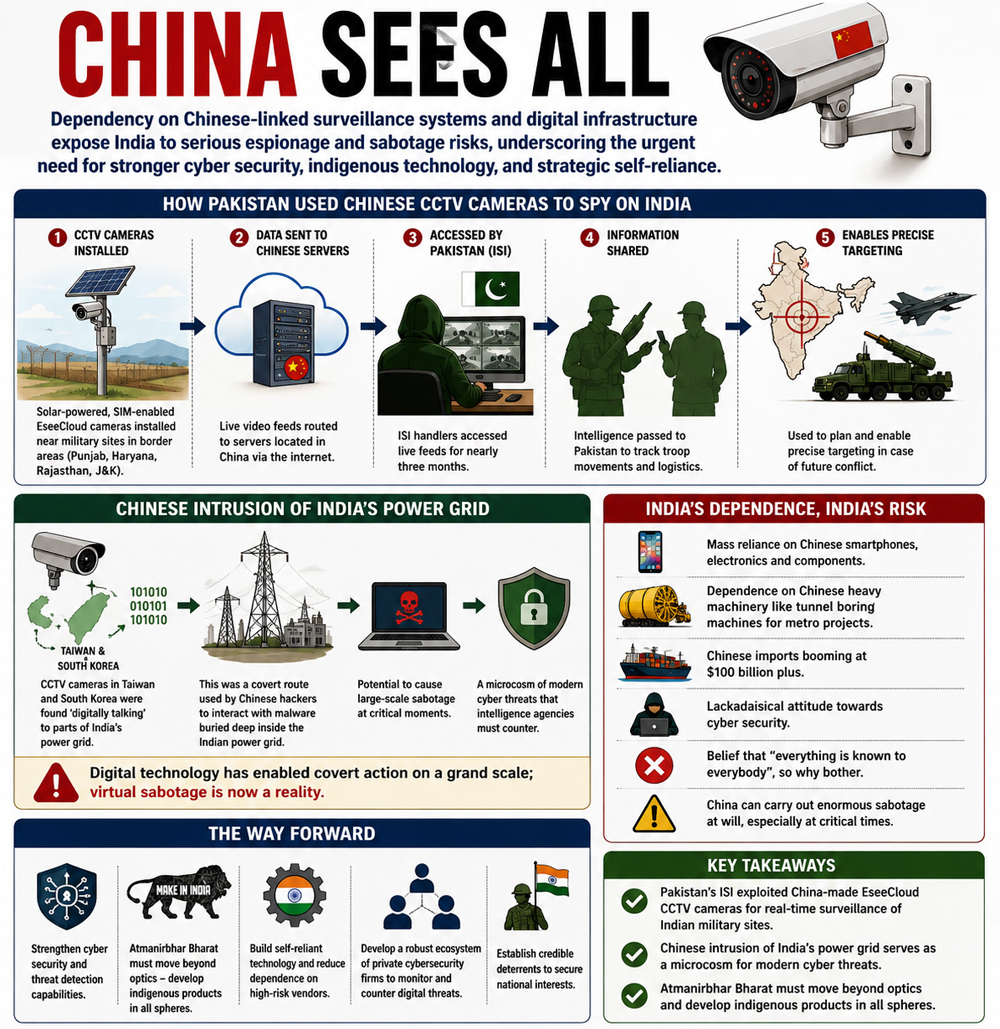
News reports of April 13, 2026, now disclose that Pakistan's Inter-Services Intelligence (ISI) has been exploiting China-made EseeCloud CCTV cameras for over three months to conduct real-time surveillance of Indian military sites, tracking troop movements and critical logistics. The operation involved solar-powered, SIM-enabled cameras near border areas in Punjab, Haryana, Rajasthan, and Jammu & Kashmir (J&K), sending data to Chinese servers before reaching Pakistan handlers.
Gaining live access to strategic assets in this manner is viewed as a low-cost, deniable surveillance method, somewhat akin to tactics used by Israeli intelligence in Iran; hacking Tehran's traffic camera network to access live surveillance feeds for tracking movements of senior officials, including Supreme Leader Ayatollah Ali Khamenei. The footage was transmitted to external servers and combined with other intelligence inputs to build detailed profiles, enabling precise targeting.
Pakistan's Inter-Services Intelligence (ISI) has been exploiting China-made EseeCloud CCTV cameras for over three months to conduct real-time surveillance of Indian military sites, tracking troop movements and critical logistics
The ISI used compromised Chinese CCTV systems to monitor Indian military installations and security infrastructure by infiltrating cameras installed near strategic assets in border states and Union Territories. The aim was to track military movements and logistics in real time and enable precise targeting in the event of a future conflict. According to senior Delhi Police officials, the ISI accessed live visual feeds for nearly three months from key defence sites and central armed police forces (CAPFs) installations across Punjab, Haryana, Rajasthan and J&K, under the pretext of monitoring truck movement in a transportation business. The feeds were routed through nine solar-powered, SIM-enabled devices linked to EseeCloud.
The Delhi Police Special Cell claimed it had busted an espionage module linked to the ISI and Babbar Khalsa International after arresting six people - three each from Punjab and Delhi. Police recovered nine CCTV cameras installed near sensitive defence and security locations in areas close to the Pakistan border; including Kapurthala, Jalandhar, Pathankot, Patiala and Moga in Punjab, as well as Ambala in Haryana, Kathua in J&K, and Bikaner and Alwar in Rajasthan. Investigations identified a network involving a Dubai-based Indian operator and an ISI handler, 'Captain Rana', with sleeper cells across Europe and Dubai.
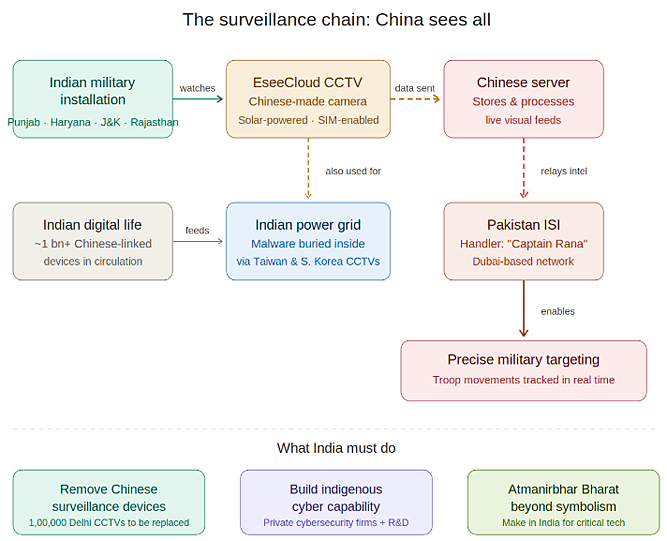
Indian security agencies have reportedly dismantled this network, removed the compromised cameras, and made several arrests. The government has also said that some 1,00,000 Chinese CCTVs in the Delhi region are also to be replaced. But is all this sufficient – definitely not!
It was reported in these columns on October 14, 2024, how India's dependence on Chinese electronic components and machinery poses a significant risk, as China could potentially carry out extensive sabotage at critical moments. The US-based company 'Recorder Future', noticed on October 7, 2024, that CCTV cameras in Taiwan and South Korea were digitally talking to crucial parts of the Indian power grid. On closer investigation, it became apparent that the strange conversation was the deliberately indirect route by which Chinese spies were interacting with malware they had previously buried deep inside the Indian power grid, or was this possible in the first place?
Chinese intrusion of India's power grid serves as a microcosm for the threats in the modern age that intelligence agencies have to contend with
The above Chinese intrusion of India's power grid serves as a microcosm for the threats in the modern age that intelligence agencies have to contend with. The cameras in Taiwan and South Korea are among more than one billion around the world, forming a metastasising network of technical surveillance – visual and electronic, ground-level and overhead, real-time and retrospective. Digital technology has enabled covert action on a grand scale; virtual sabotage is now a reality. Also, private entities like Microsoft and Future Recorder can monitor and analyse the enormous quantities of digital data flowing out of digital devices in real time to detect virtual threats.
These modern era threats and increasing concerns about the cybersecurity risks of Chinese technology in critical infrastructure, has prompted bans of such Chinese products in the US, the UK, and Australia. But what about India? Indians are increasingly using Chinese smartphones. The Indian economy is almost entirely based on Chinese electronics. India is also dependent on Chinese heavy machinery like tunnel boring machines for metro railway lines. All this was adopted as an easy way out for mass production so that the poor could have mobiles, TV, fans and the like. The Indian corporate continues to enjoy the benefit of cheap Chinese components resulting in Chinese imports booming at $100 billion plus.
Atmanirbhar Bharat must move beyond optics and develop indigenous products in all spheres
The general attitude in India towards cyber security is lackadaisical. Some even say that everything is known to everybody (especially China and the US), so why bother. It is also said that it is not possible for India to decouple from China, which is true. But should we not see anything and everything Chinese with suspicion and adopt appropriate measures? China can carry out enormous sabotage at will, especially at critical times. The daily lives of individuals rely more than ever on digital technology: more things run on software (fridges, cars, phones), those things have a greater array of sensors (GPS receivers and radio transmitters) and they are increasingly connected, often over the internet, allowing data, often embodying our most personal secrets, flowing to and from.
Finally, the rise of private intelligence companies, capable of monitoring and analysing vast quantities of digital data, has transformed espionage into a high-stakes technological competition, challenging state agencies. India must develop a robust ecosystem of private cybersecurity firms to detect and counter digital threats in real time, alongside establishing credible deterrents to secure national interests. More importantly, Atmanirbhar Bharat must move beyond optics and sloganeering – 'Make in India' progressing beyond symbolism, developing indigenous products in all spheres.