






The insightful articles, inspiring narrations and analytical perspectives presented by the Editorial Team, establish an alluring connect with the reader. My compliments and best wishes to SP Guide Publications.

"Over the past 60 years, the growth of SP Guide Publications has mirrored the rising stature of Indian Navy. Its well-researched and informative magazines on Defence and Aerospace sector have served to shape an educated opinion of our military personnel, policy makers and the public alike. I wish SP's Publication team continued success, fair winds and following seas in all future endeavour!"

Since, its inception in 1964, SP Guide Publications has consistently demonstrated commitment to high-quality journalism in the aerospace and defence sectors, earning a well-deserved reputation as Asia's largest media house in this domain. I wish SP Guide Publications continued success in its pursuit of excellence.
India's attempt to indigenise combat free fall parachutes has been marred by years of delays, high failure rates, safety concerns, and audit criticism, raising serious questions about defence preparedness, accountability, and the effectiveness of domestic military research and procurement systems
 |
The Author is Former Director General of Information Systems and A Special Forces Veteran, Indian Army |
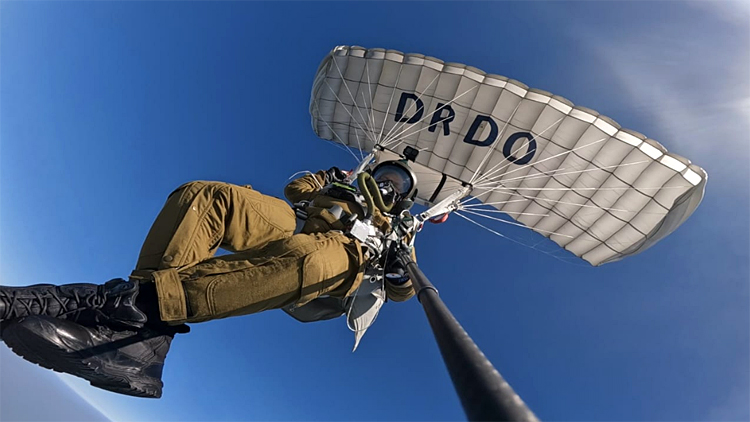
It was covered in these columns on December 27, 2025 that the Defence Research and Development Organisation (DRDO) had developed an indigenous Military Combat Parachute System. The push for indigenisation under self-sufficiency in defence (Atmanirbhara in Defence) was to cease India's long dependence on imported parachutes, facing failures and procurement issues. The DRDO's breakthrough in developing the Military Combat Parachute System (MCPS) in 2025, was to enable high-altitude deployment and reduce foreign dependence.
Before launching the Indian Peace Keeping Force (IPKF) in Sri Lanka during 1987, India imported parachutes from France and South Korea to meet the requirements of any possible airborne operations. No paradrop of troops was undertaken as part of IPKF operations in Sri Lanka. However, it is significant to note that the DRDO did not have the requisite compatible equipment to test the imported French and South Korean parachutes. When the DRDO tested these imported parachutes with its own testing apparatus, these parachutes suffered tears because of additional strain and pressure.
The reports of January 8, 2026 have disclosed that this indigenous Military Combat Parachute System (MCPS), development of which took 13 years with crores of rupees spent, have not only failed field trials but have also been classed as "seriously life threatening"
In 2008, the Indian Air Force (IAF) ordered 600 Combat Free Fall (CFF) parachutes from the US as part of a deal for C-130 Hercules aircraft. Data from 2023 shows that the US was India's top import partner for parachutes, followed by countries like the Czech Republic and Vietnam, and China. But India stopped relying solely on imported free-fall parachutes from the US and moved towards domestic production following a critical 2016 Comptroller and Auditor General (CAG) report. The report revealed that a 2008 deal for US-made parachutes, specifically the C-130 Hercules chutes, suffered from a high failure rate during trials in 2014. In 2012, the media reported a scam involving the import of parachutes for India's Special Frontier Force (SFF). The Ministry of Defence (MoD) ultimately aborted the procurement process after a detailed inquiry report was submitted to the Cabinet Secretariat.
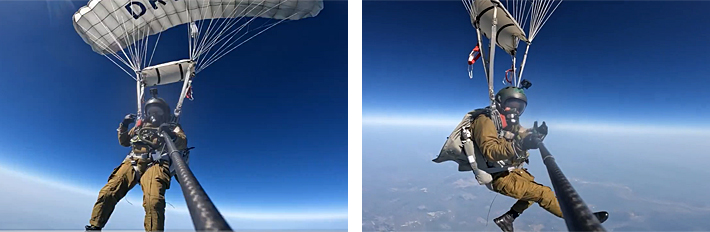
In October 2025, the DRDO claimed a major milestone in critical defence technologies by indigenously developing the MCPS. A successful CFF jump was undertaken from an altitude of 32,000 opening the doors for induction of this indigenous parachute system that will reduce dependency on imports and serviceability of parachute systems. Visuals showed DRDO written prominently on the CFF parachute canopy. The MCPS has been designed by DRDO's Aerial Delivery Research and Development Establishment (ADRDE), Agra, and the Bengaluru-based Defence Bioengineering and Electromedical Laboratory.
The CAG has raised questions about ADRDE, the sole institution in India for development of military-grade parachutes, on its claim of successful trials of CFF chutes, pointing out that an overwhelming 75 per cent of the chutes had failed field trials
However, the reports of January 8, 2026 have disclosed that this indigenous MCPS, development of which took 13 years with crores of rupees spent, have not only failed field trials but have also been classed as "seriously life threatening", according to an audit report by the CAG, which slammed the functioning of the lab and the indigenous manufacturer. The report released on January 7, 2026, is part of an audit of Army ordnance factories and defence PSUs by CAG, which has pointed out serious lapses on the part of the Aerial Delivery Research and Development Establishment (ADRDE) in Agra and the Ordnance Parachutes Factory (OPF) in Kanpur for allegedly failing to produce combat free fall (CFF) parachutes, despite ₹10.75 crore in expenses and years of trials.
The CAG has raised questions about ADRDE, the sole institution in India for development of military-grade parachutes, on its claim of successful trials of CFF chutes, pointing out that an overwhelming 75 per cent of the chutes had failed field trials. CFF parachutes are used by elite paratroopers for highly specialised operations. The media report goes on to say that in 1986, a batch of them had been imported and, with a shelf life of 10 years, had been finally decommissioned in 2002, being no longer operationally worthy. In 2001, the Army placed an order for 1,031 CFF parachutes, of which 410 were to be procured from abroad on a fast-track basis for urgent needs. The remaining 621 were to be produced under a project by ADRDE which started in March 2003. However, in 2006, the MoD ended the import idea, suggesting these chutes also be procured internally.
Despite urgent requirements for CFF parachutes since 2001, the MoD neither bought them from abroad nor through indigenous sources till December 2012
Between March and November 2006, ADRDE conducted trials for the CFFs it had developed and claimed these had been successful. The MoD then placed an order with OPF Kanpur to make 700 of the parachutes in October 2008, at a total cost of ₹55.35 crore. OPF was to deliver a sample of 40 for further trials. However, according to the CAG report, in 2010, trials of the parachutes found them deficient in quality, with the expert team saying the implications of the flaws were "seriously life threatening". Despite this, the MoD went ahead and in July 2011 ordered two consignments of 25 parachutes each. In October 2014, of the first 25 chutes, only seven passed trials. The failure rate of 75 per cent, said the CAG report, raised serious questions about the claims by ADRDE as well as the manufacturer, OPF. Meanwhile, in January 2008, the IAF signed a deal with the US government to buy C-130 Hercules aircraft, and with them 600 CFF chutes. Of these, 400 were given to the Army in January 2013.
"Despite urgent requirements for CFF parachutes since 2001, the MoD neither bought them from abroad nor through indigenous sources till December 2012. This resulted in non-availability of parachutes for the Army's immediate operational needs for over a decade," the CAG report remarks, while also questioning the functioning of both ADRDE and OPF. ADRDE Director Debasish Chakraborti was not available for comment following the release of the CAG report, according to the news report.
This is a sad commentary of the functioning of the DRDO and the MoD, with no accountability and total disregard to safety of the Armed Forces personnel, as well as meeting operational requirements. The gravity is more because these chutes are meant for airborne forces who are trained and deployed on specific missions that are not run of the mill. Whether any serious introspection and accountability will follow, remains suspect, given the bureaucratic-DRDO nexus, which is also the reason why the reorganisation of the DRDO continues to drag despite government directions. A suggestion on social media is when the President of India can take a dive in a submarine, the defence minister along with few MoD bureaucrats should jump with chutes claimed "successful". This would pressure the DRDO to doubly ensure the safety of these chutes.