






The insightful articles, inspiring narrations and analytical perspectives presented by the Editorial Team, establish an alluring connect with the reader. My compliments and best wishes to SP Guide Publications.

"Over the past 60 years, the growth of SP Guide Publications has mirrored the rising stature of Indian Navy. Its well-researched and informative magazines on Defence and Aerospace sector have served to shape an educated opinion of our military personnel, policy makers and the public alike. I wish SP's Publication team continued success, fair winds and following seas in all future endeavour!"

Since, its inception in 1964, SP Guide Publications has consistently demonstrated commitment to high-quality journalism in the aerospace and defence sectors, earning a well-deserved reputation as Asia's largest media house in this domain. I wish SP Guide Publications continued success in its pursuit of excellence.
The acquisition of high-speed drone systems marks a decisive shift in the Army's doctrine toward deep-penetration precision strikes.
 |
The Author is Former Director General of Information Systems and A Special Forces Veteran, Indian Army |

Speaking at a press conference ahead of Army Day 2026, the Army Chief General Upendra Dwivedi signalled a paradigm shift in military aviation and indigenous manufacturing, saying that the Army plans large-scale production-cum-deployments of long-range combat drones across all Military Commands. He confirmed that every military command is now actively manufacturing or procuring thousands of combat-capable drones to bolster self-reliance in defence technology.
He outlined an ambitious "decentralised innovation" model, moving away from traditional, centralised procurement processes that often take years. Under this new initiative, each of the Army's operational commands has been empowered to manufacture or induct approximately 5,000 unmanned aerial systems (UAS). This collective effort is creating a vast, distributed arsenal tailored specifically to local threat perceptions and geographical realities.
Clarifying the nature of these platforms, the Army Chief emphasised that the focus is strictly on military-grade combat systems. The new fleet includes long-range tactical strike drones and loitering munitions capable of operating deep within contested airspace. According to recent reports, the Army has successfully test-fired indigenous drones with strike ranges exceeding 100-km.
The induction of Berkut-BM drones underscores the Indian Army's evolving focus on fast, expendable platforms capable of neutralising high-value targets deep within enemy territory.
This restructuring aims to embed drone warfare capabilities directly into infantry and mechanised columns rather than keeping them as isolated support assets. Commands in high-altitude are prioritising endurance platforms engineered to function in the thin air and sub-zero temperatures of the Himalayas. Desert formations are focusing on drones extended ranges and optical stability for vast, open terrain surveillance. Eastern Command is developing stealthy drones with low acoustic signatures, optimised for jungle warfare and reduced visibility. The strategic intent behind this "mass-drone doctrine" is to overwhelm adversary defences through saturation.
In 2025, China had ordered one million kamikaze drones for delivery in 2026.
According to news reports of January 21, 2026, the Indian Army has begun to receive the Berkut-BM single-use attack drones from Belarus for long-range precision strike missions; a move to significantly bolster the Army's offensive unmanned warfare capabilities. The Berkut-BM drones have been playing a central role in the war in Ukraine. The Berkut-BM is a jet-powered platform developed by the firm 'Indela', and reportedly uses a Chinese-made micro turbojet engine produced by 'Swiwin'. The use of a jet engine significantly increases the aircraft's cost, but provides a high dash speed and short engagement timeline that allows it to strike time-sensitive battlefield targets, reducing reaction times to relocate and the window for interception.
The acquisition of this high-speed system marks a decisive shift in the Army's doctrine toward deep-penetration precision strikes. The Berkut-BM traces its lineage to high-speed aerial targets originally developed for air defence training. This design has been leveraged to create a potent strike weapon. The airframe's compact size, agility, and turbojet propulsion make it an elusive target for adversaries. It fills a critical niche between slower, cheaper loitering munitions and larger, more expensive combat UAVs, offering a cost-effective solution for saturation attacks.
The Army aims to establish a persistent surveillance and rapid strike capability that spans the entire tactical and operational depth of the battlefield.
The Berkut-BM differs from conventional propeller-driven loitering munitions, in that, its propulsion and speed. Its technical specifications and performance includes: Engine and Speed - powered by a compact turbojet engine integrated between twin tail booms, the drone can achieve dash speeds of Mach 0.34 (up to 500 km/h), drastically reducing the reaction time available to enemy air defence systems and complicating interception efforts; Range and Endurance – the drone has an operational range of 180 km and can remain airborne for approximately 45 minutes, depending on the flight altitude and mission requirements; Payload – the drone carries a 10-kg high-explosive fragmentation warhead, optimised to inflict severe damage on radar installations, lightly armoured columns, and enemy soldiers.
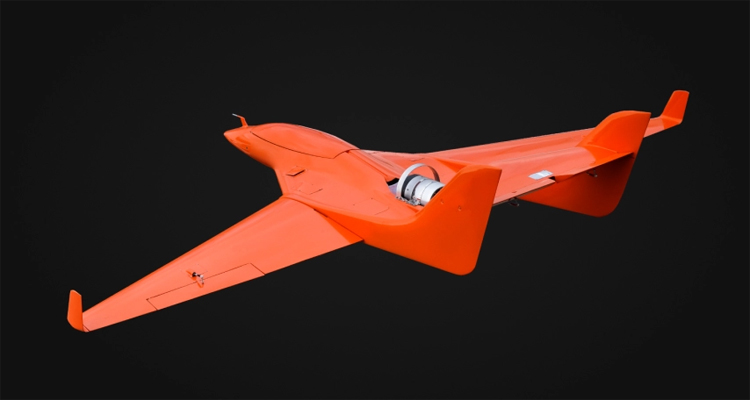
Operationally, the Berkut-BM offers commanders significant flexibility since the system is catapult-launched, eliminating the need for prepared runways or complex airfields. Such a capability allows the drone to be deployed from concealed, forward positions or mobile launchers, adding a layer of unpredictability to battlefield manoeuvres. The acquisition comes amidst a broader push for modernisation driven by lessons learned from recent global conflicts and operational reviews.
The induction of Berkut-BM drones underscores the Indian Army's evolving focus on fast, expendable platforms capable of neutralising high-value targets deep within enemy territory. Unlike traditional surveillance drones, the Berkut-BM is designed specifically for offensive operations. Its primary mission profile involves the suppression of enemy air defences (SEAD), the destruction of artillery networks, and the crippling of command-and-control infrastructure during the critical opening phases of high-intensity conflicts. Military analysts view such assets as essential for striking hostile surface-to-air missile (SAM) batteries, multiple-launch rocket systems (MLRS), and logistical nodes without exposing manned aircraft or ground troops to unnecessary risk. The Army aims to establish a persistent surveillance and rapid strike capability that spans the entire tactical and operational depth of the battlefield.
In a significant development, two Turkish 'Kizilelma' unmanned fighter jets performed the world's first successful autonomous close formation flight between combat-capable jets
The Defence Research and Development Organisation (DRDO) is planning a new Drone Swarm system under its Technology Development Fund (TDF) scheme; aimed at developing sophisticated close formation flying" capabilities, allowing multiple drones to coordinate with precision to function as a single, massive aerial system, according to news reports of December 20, 2025. In this configuration each drone carries a specific radiating element - a transmitter or receiver. When operating in unison, the swarm acts as a distributed phased array or a virtual antenna, allowing the cluster of small drones to generate powerful radio frequency (RF) beams for communication, radar sensing, and electronic warfare (EW) that would typically require a much larger, heavier, and more expensive single-platform aircraft. Also, the swarm is dynamically reconfigurable; it can change its shape in real-time to alter the antenna's beamwidth or direction, adapting instantly to fresh operational requirements.
For the virtual antenna to work, the drones must maintain their relative positions with centimetre-level accuracy while flying just metres apart. This necessitates the use of advanced navigation systems that can operate even when satellite navigation (GPS/NavIC) is denied. The project places heavy emphasis on Electronic Counter-Countermeasures (ECCM). Since the swarm relies on constant data sharing to stay coordinated, the communication links between the drones must be robust enough to withstand enemy jamming attempts in contested airspace. The technology promises to be a force multiplier in surveillance and electronic intelligence (ELINT) missions. This initiative holds immense potential for modern asymmetric warfare.
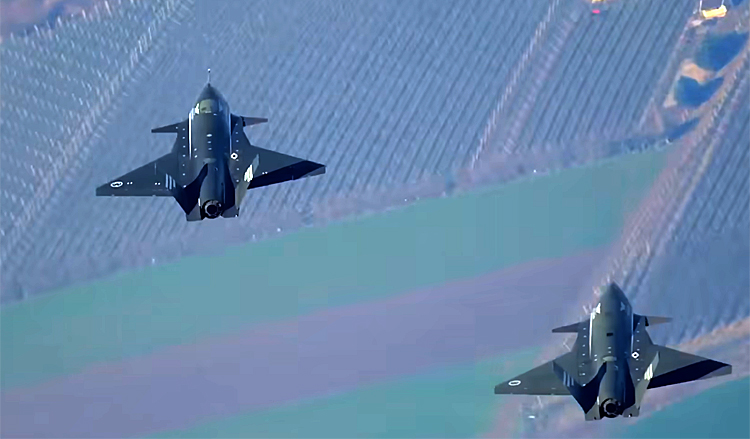
In a significant development, two Turkish 'Kizilelma' unmanned fighter jets performed the world's first successful autonomous close formation flight between combat-capable jets, according to information released by the Turkish Company Baykar on December 28, 2025. The flight was executed without any human input, relying entirely on onboard artificial intelligence, sensors, and real-time data sharing. This breakthrough signals a major shift toward AI-driven air combat and strengthens Turkey's position as a leading developer of next-generation unmanned aviation.
No country has publicly demonstrated this level of coordination between unmanned fighter-class aircraft under fully autonomous control. Baykar's Kizilelma platform represents a new generation of jet-powered unmanned systems engineered for high-speed, high-agility operations. Unlike traditional drones designed primarily for ISR (intelligence, surveillance, reconnaissance) or light-strike roles, it integrates stealth shaping, internal weapons bays, AI-driven flight control, and beyond-line-of-sight communications, offering capabilities previously reserved for fifth-generation manned aircraft. Powered by a single turbofan engine, the Kizilelma features a maximum takeoff weight of about 6,000-kgsand is designed for both land-based and carrier-based operations. The strategic implications of this achievement opens the door to scalable, AI-driven air combat architectures where formations of unmanned fighters can operate with minimal human oversight, execute synchronized attacks, or serve as force multipliers alongside manned aircraft.