




The insightful articles, inspiring narrations and analytical perspectives presented by the Editorial Team, establish an alluring connect with the reader. My compliments and best wishes to SP Guide Publications.
"Over the past 60 years, the growth of SP Guide Publications has mirrored the rising stature of Indian Navy. Its well-researched and informative magazines on Defence and Aerospace sector have served to shape an educated opinion of our military personnel, policy makers and the public alike. I wish SP's Publication team continued success, fair winds and following seas in all future endeavour!"

Since, its inception in 1964, SP Guide Publications has consistently demonstrated commitment to high-quality journalism in the aerospace and defence sectors, earning a well-deserved reputation as Asia's largest media house in this domain. I wish SP Guide Publications continued success in its pursuit of excellence.
Defence Minister Rajnath Singh's recent visit to Germany resulted in expanding India-Germany defence cooperation, submarine technology collaboration under Project-75(I), defence industrial partnerships, and broader strategic and maritime security discussions
 |
The Author is Former Director General of Information Systems and A Special Forces Veteran, Indian Army |
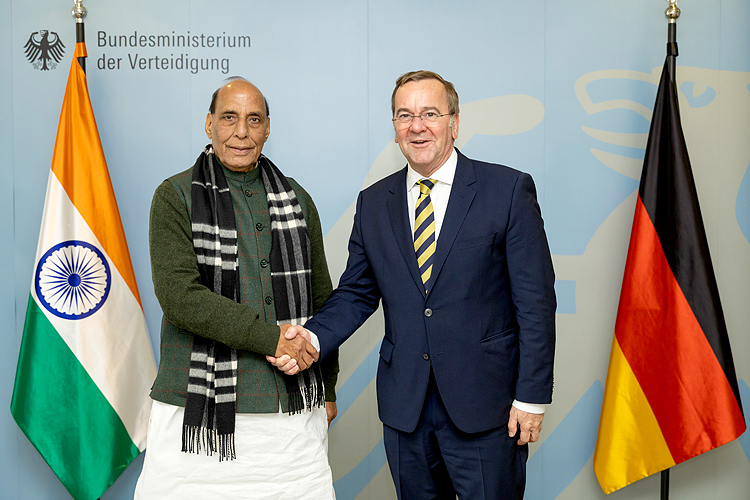
During his recent visit to Germany, Defence Minister Rajnath Singh held delegation-level talks with his German counterpart Boris Pistorius in Berlin, with the discussions centred on strengthening bilateral defence cooperation between India and Germany According to the Ministry of Defence (MoD), the talks covered a wide spectrum of issues, including enhancing defence industrial collaboration, deepening military-to-military engagements, and exploring cooperation in emerging domains like cybersecurity, artificial intelligence (AI), and drone technologies.
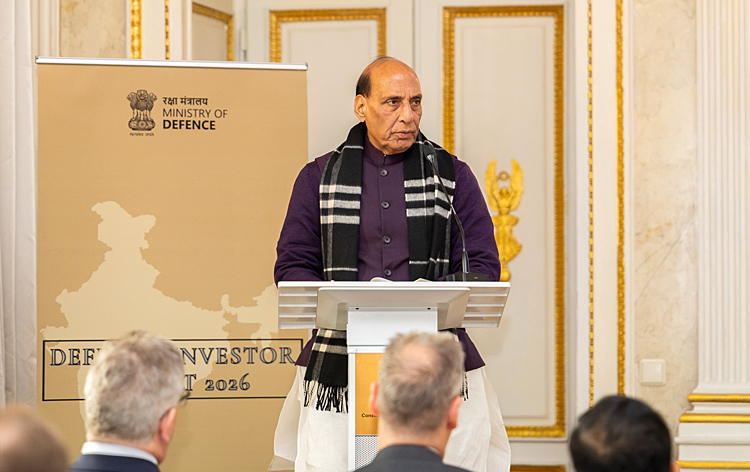
On April 23, Rajnath was accorded a ceremonial welcome. He also laid a wreath at the Ehrenmal der Bundeswehr, paying tribute to fallen soldiers, following his interaction with the Indian diaspora and his address to the German Parliamentary Standing Committee on Defence and Security. Addressing the Indian community in Berlin, he said that while India has attempted to play a role in peace efforts, timing is crucial, and it remains possible that India may assume a larger role in future. Rajnath also drew attention to India's diplomatic outreach in ensuring maritime stability, noting that such efforts had enabled multiple Indian vessels to safely transit the Strait of Hormuz.
The visit of Defence Minister Rajnath Singh highlighted India's ongoing negotiations under Project-75(I) and its push for indigenous defence manufacturing with technology transfer
Addressing the German Parliamentary Standing Committee on Defence and Security, Rajnath reiterated India's concerns over energy security, stressing that disruptions in the Strait of Hormuz have direct consequences for India's economy and stability, given the country's heavy dependence on the West Asian region for energy supplies. He emphasised that such disruptions are not distant events but immediate challenges with significant implications for national security and economic interests.
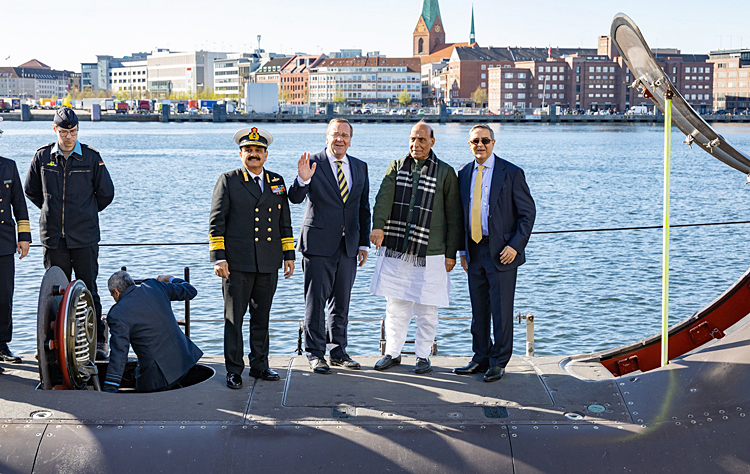
Defence Minister Rajnath Singh then visited the ThyssenKrupp Marine Systems (TKMS) shipyard in Kiel, Germany, where he boarded a Type-212 class submarine, underscoring India's interest in advanced German submarine technology and strengthening defence industrial collaboration.
The TKMS shipyard is one of Europe's leading centres for submarine construction. The Type-212 class submarine is renowned for its advanced stealth features, air-independent propulsion (AIP) system, and operational efficiency in shallow and deep waters.The Type-212 class submarine is considered one of the most sophisticated conventional submarines. The fuel-cell based AIP technology allows it to remain submerged for extended periods without surfacing.
German Defence Minister Boris Pistorius told reporters that he was "very, very confident" of signing the deal soon, adding that he expected the agreement to be finalised within the next three months
The visit highlighted India's ongoing negotiations under Project-75(I) and its push for indigenous defence manufacturing with technology transfer. These submarines are expected to be built in India by Mazagon Dock Shipbuilders Limited (MDL), with full technology transfer from TKMS. Rajnath Singh's engagement at TKMS also highlighted the importance of industrial collaboration between Indian and German defence companies. By boarding the Type-212 submarine, he sent a clear signal of India's commitment to modernising its ageing submarine fleet and enhancing maritime deterrence. The visit reinforced India's emphasis on acquiring cutting-edge technologies while ensuring domestic production capabilities.
German Defence Minister Boris Pistorius told reporters on April 23 that he was "very, very confident" of signing the deal soon, adding that he expected the agreement to be finalised within the next three months. The planned collaboration, valued at approximately $8 billion, has been under discussion for several months. The project represents a significant step forward in bilateral defence cooperation, with both sides working to align industrial and strategic priorities.
The proposed $8 billion TKMS-Mazagon Dock submarine programme would give India six new conventional attack submarines with a much stronger underwater endurance, stealth and sensor suite than the ageing boats that currently dominate the Indian Navy's conventional force. The project is also strategically important because it is tied to domestic construction in India, technology transfer, and a gradual rise in indigenous content, which supports longer-term naval self-reliance.
The proposed $8 billion TKMS-Mazagon Dock submarine programme would give India six new conventional attack submarines with a much stronger underwater endurance, stealth and sensor suite
India's present submarine force is still relatively small and heavily dated at the conventional end: one source says the Navy currently operates seventeen diesel-powered attack submarines and one nuclear ballistic missile submarine, while another notes much of the conventional fleet is over 25 years old and many boats have needed refits.
The German offer is based on a customised Type 214-derived design tailored for Indian requirements, with air-independent propulsion, lithium-ion batteries and improved stealth features. According to sources, the design is intended to be built at Mazagon Dock, with TKMS providing design authority, engineering expertise and technical consultancy.
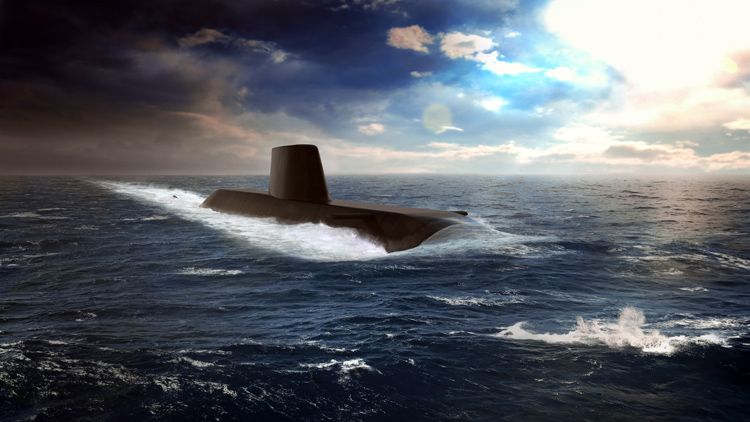
Air-independent propulsion is the key selling point, because it lets a conventional submarine remain submerged for much longer without snorkelling, improving survivability and reducing detection risk. In practical terms, that means these submarines should be far better suited for long-endurance operations in the Arabian Sea, Bay of Bengal and chokepoint-heavy approaches around the Malacca-linked Indian Ocean routes.
The indigenous content is expected to start at around 45 per cent and rise to nearly 60 per cent by the final boat, which would make the programme more than a simple import and more of an industrial partnership. This would narrow the gap but not erase it. China's Yuan-class conventional submarines already use AIP and quieting technologies, with open indicating that Chinese conventional submarines are among the more modern in the region. India's new submarines would therefore help restore some balance, but China's broader undersea fleet depth remains larger. Pakistan's undersea modernisation, aided by Chinese support, has forced India to prioritise survivable conventional submarines that can hold an adversary's surface fleet and sea lines at risk.
Air-independent propulsion is the key selling point, because it lets a conventional submarine remain submerged for much longer without snorkelling, improving survivability and reducing detection risk."
Concurrent to India and Germany signing a Defence Industrial Cooperation Roadmap during Rajnath's visit and the proposed P-75(I) submarine deal, Germany released the document the GesamtkonzeptionmilitärischeVerteidigung, the "overall conception of military defence", Germany's first formal military strategy since 1949. This indicates Germany shedding its post-war suppression of strategic ambition. The document is a resolve to make Germany the strongest conventional army in Europe.
The new strategy names Russia as the largest and most immediate threat to German, European and transatlantic security. Citing the US 2026 National Defense Strategy, it calls for allies to take greater responsibility for their own security; implying NATO must become more European to remain transatlantic. This move by Germany alters the balance India has historically managed between Washington, Moscow, and Europe. This change could influence India's foreign policy decisions, alliances, and its capability to navigate between competing blocs. More importantly, how would this affect the India-Russia relations, including import of Russian oil and India's dependence on Russian weapon platforms.
Is this why the India-Russia Reciprocal Exchange of Logistics Support Agreement (RELOS) has been made public now, under which both sides may station up to 3,000 troops, five warships, and ten military aircraft on each other's territory? Will Germany consider India an ally of its primary enemy – Russia? What happens then to the India-Germany defence collaboration in the long run and the German technology India is seeking?