



The insightful articles, inspiring narrations and analytical perspectives presented by the Editorial Team, establish an alluring connect with the reader. My compliments and best wishes to SP Guide Publications.
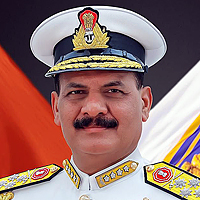
"Over the past 60 years, the growth of SP Guide Publications has mirrored the rising stature of Indian Navy. Its well-researched and informative magazines on Defence and Aerospace sector have served to shape an educated opinion of our military personnel, policy makers and the public alike. I wish SP's Publication team continued success, fair winds and following seas in all future endeavour!"

Since, its inception in 1964, SP Guide Publications has consistently demonstrated commitment to high-quality journalism in the aerospace and defence sectors, earning a well-deserved reputation as Asia's largest media house in this domain. I wish SP Guide Publications continued success in its pursuit of excellence.
The Saudi Arabia–Pakistan–Turkey agreement signed in Mecca on August 7, 2026, establishes a mutual defence alliance where an attack on one member is considered an attack on all, combining Pakistani military manpower/nuclear deterrence, Turkish drone technology, and Saudi capital
 |
The Author is Former Director General of Information Systems and A Special Forces Veteran, Indian Army |
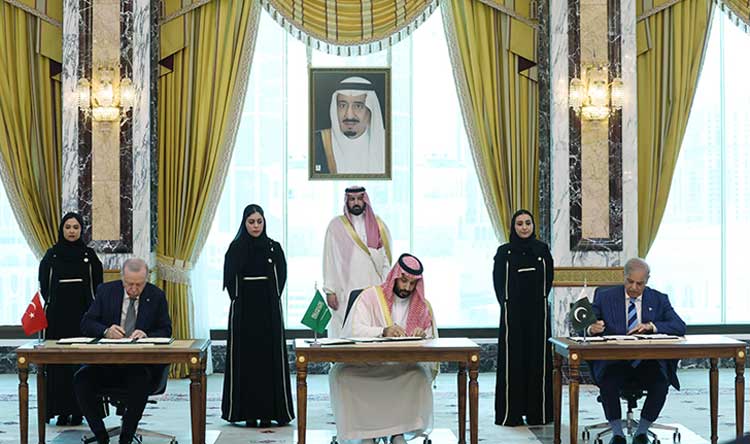
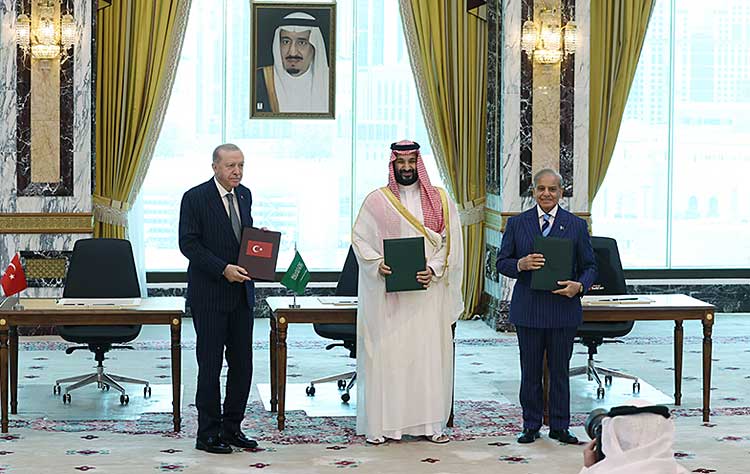
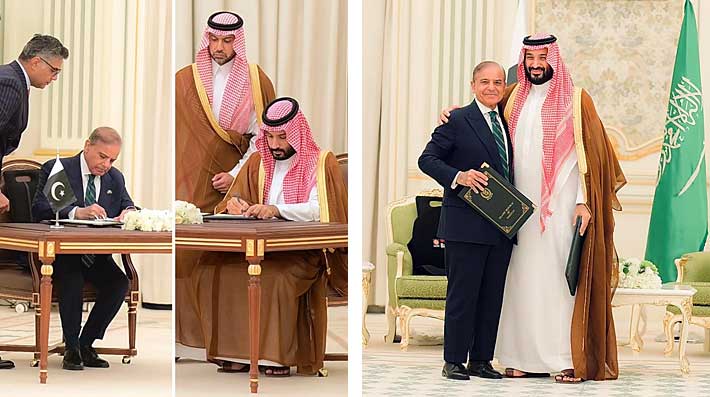
Signing of the Saudi Arabia-Pakistan Defence Agreement (SPDA) signed on September 17, 2025 was covered in these columns last year. Notably, signing of the SPDA followed the emergency summit of 40 Arab-Islamic nations at Doha on September 15, after Israeli planes struck a residential compound in Doha, targeting Hamas, green lighted by the US. The Arab-Islamic emergency summit was also attended by Pakistan and Turkey. Pakistan's defence minister, Khawaja Mohammad Asif, later said that Pakistan's nuclear weapons would be made available to Saudi Arabia under the terms of the SPDA.
After the SPDA, Turkey, Saudi Arabia and Pakistan signed a defence agreement in Mecca on August 7, 2026. The agreement states that an armed attack on one will be regarded as an attack on all, resembling NATO's Article 5. Some analysts have jumped to the conclusion that this alliance should not be termed "Islamic NATO" (despite all three being Muslim countries) on the plea that the agreement does not specify the nature or scale of assistance. But such an assumption is politically motivated keeping the Muslim vote bank in mind.
Under the precursor Saudi-Pakistan Defence Agreement (SPDA), Pakistan deployed 8,000 ground troops (scalable to 80,000), a squadron of ~16 JF-17 fighters, two UAV surveillance squadrons, and HQ-9 long-range SAM systems to Saudi Arabia in exchange for billions in financial rollovers and credit facilities.
Take the case of the SPDA, which also does not explicitly specify the nature and scope of the military assistance to each other. The text is silent on whether Saudi Arabia comes under Pakistan's nuclear umbrella with this agreement. However, after signing of the SPDA in September 2025, Pakistan provided a substantial air, ground, and air-defence deployment to Saudi Arabia that materialised in April 2026 amid heightened Middle East tensions following the outbreak of the US/Israel–Iran war. The package consists of the following specific assistance:
In exchange for this rapid deployment of military assets, Pakistan secured vital economic relief, including a $3 billion cash deposit rollover in April 2026 and an additional $5 billion financial facility from Saudi Arabia in July 2026.
The Turkey-Saudi Arabia-Pakistan defence agreement signed in Mecca on August 7, 2026, is in effect a strategic integrated and trilateral expansion of the SPDA, looping in Turkey. It reflects "Islamic NATO synergy, under which Pakistan contributes its operational military manpower and implicit nuclear deterrence weight, while Turkey provides advanced drone tech and Saudi Arabia provides massive financial capital.
The alliance is eyeing expansion to include nations like Egypt and Bangladesh, creating a complex, multipolar security web on India's eastern and western flanks alongside existing China-Pakistan-Turkey defense ties.
Pakistan's Defence Minister Khawaja Asif has connected Operation Sindoor to the Mecca Joint Defence Agreement signed between Pakistan, Saudi Arabia and Turkey. While the three countries describe the pact as defensive, Asif's comments have introduced India into the equation, particularly in relation to its expanding cooperation with Afghanistan.
Turkey has already hinted that the grouping could expand beyond three countries, with Egypt mentioned as a possible addition. Such an expansion would mark the emergence of a new regional security equation – Muslim NATO, institutionalising collective defence among key Muslim-majority states, reducing reliance on external powers. The evolving situation underscores the shifting balance of power in West Asia. With Iran, Israel and the US locked in confrontation, the Mecca Agreement adds a new layer of collective defence among Sunni-majority states. For India, this development demands close scrutiny, as it could alter strategic calculations in any future conflict with Pakistan.
While China continues expanding its J-20 stealth fleet and supplying Pakistan with 40 5th-generation J-35A stealth fighters, India's prospective Rafale purchases are non-stealth 4.5-generation platforms, widening the technological air combat gap prior to the AMCA's arrival.
The Mecca Defence Agreement certainly poses more than simple hybrid threats to India. The Mecca Agreement is being viewed as an effort of Arab/Muslim countries to veer away from the US but this may take many years, if not decades, in the case of Saudi Arabs. Pakistan anyway must play protégé to both the US and China. Donald Trump promoted the SPDA, hoping Saudi Arabia would lead Arab Nations to join the Abraham Accords.
Arab nations may not join the Abraham Accords but Trump will support the Mecca Defence Agreement, hoping it will destabilise South Asia and ignite an India-China war, for the US to advance its strategic and economic interests. The antics of US Ambassador to India Sergie Gor's actions in this context are noteworthy: visit to Dhaka after which Bangladesh Prime Minister Tarique Rahman has hardened his stance towards India; announcing in Srinagar that Kashmir is an "important" (not integral) part of India simultaneous to Chinese and Turkish aircraft unloading military equipment and drones in Pakistan; vising Ladakh and attempting to meet the Dalai Lama to annoy China.
The converging defense pacts and shifting regional geopolitics demand that India fundamentally re-evaluate its military transformation strategies and theater command structures.
China's existing J-20 fleet of 500 is set to double by 2030 and Beijing has signed a deal with Pakistan to supply 40 J-35A 5th-generation stealth fighters, with first batch arriving in coming months – much before India's AMCA. Moreover, none of the 114 additional Rafale India plans to procure will be 5th-generation - Rafale platform is not built with a 5th-generation low-observable (stealth) airframe. Deliveries are projected to begin in late 2029 or 2030, stretching through mid-to-late 2030s.
The China-Turkey-Pakistan trilateral already poses a significant threat to India. Dhaka's is upping defence arrangements with China, Pakistan and the US. Its defence agreements with Turkey for long-range air systems and co-produced drones creates a complex, multipolar web on India's eastern flank.
Finally, as for the news that Dhaka is considering joining the Mecca Defence Agreement, it should be taken for granted that Bangladesh will do so egged on by both China and the US. India cannot afford to take all this lightly; it must seriously review its proposed military transformation only three border specific Theatre Commands – that too worked out without a National Security Strategy.