






The insightful articles, inspiring narrations and analytical perspectives presented by the Editorial Team, establish an alluring connect with the reader. My compliments and best wishes to SP Guide Publications.

"Over the past 60 years, the growth of SP Guide Publications has mirrored the rising stature of Indian Navy. Its well-researched and informative magazines on Defence and Aerospace sector have served to shape an educated opinion of our military personnel, policy makers and the public alike. I wish SP's Publication team continued success, fair winds and following seas in all future endeavour!"

Since, its inception in 1964, SP Guide Publications has consistently demonstrated commitment to high-quality journalism in the aerospace and defence sectors, earning a well-deserved reputation as Asia's largest media house in this domain. I wish SP Guide Publications continued success in its pursuit of excellence.
Sir Creek's strategic location, disputed boundary and difficult marshland terrain make it critical to India's coastal security, surveillance and amphibious warfare preparedness.
 |
The Author is Former Director General of Information Systems and A Special Forces Veteran, Indian Army |
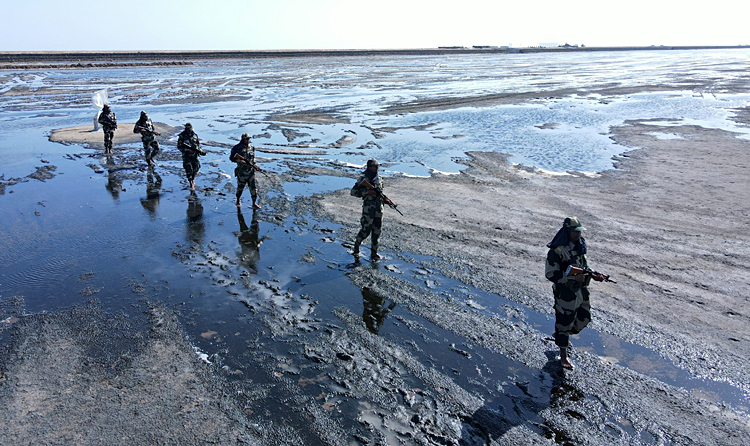
The strategic importance of Sir Creek, a 96-km tidal estuary in the Rann of Kutch dividing India's Gujarat state and Pakistan's Sindh province, stems from its influence over national security, valuable maritime resources (including suspected oil and gas reserves), and its role as a potential launching pad for cross-border infiltration or military manoeuvres. Control over the creek dictates the demarcation of the Exclusive Economic Zone (EEZ) and continental shelf extending into the Arabian Sea. Resolving this determines which nation holds the rights to explore valuable hydrocarbons and minerals potentially hidden in the seabed.
Sir Creek is strategically important because its disputed boundary affects the delineation of India and Pakistan's EEZ and continental shelf, potentially determining access to seabed resources.
The area remains one of the most sensitive territorial disputes outside Jammu and Kashmir (J&K). India maintains that the demarcation line should run through the middle of the water body, in line with international convention, while Pakistan claims the entire creek, asserting the eastern bank as the boundary. This disagreement is not merely symbolic, as under the UN Convention on the Law of the Sea, the land boundary terminus at Sir Creek determines the starting point of each country's EEZ. Even a minor shift in the boundary could translate into thousands of square kilometres of maritime territory, making the dispute strategically significant.

Sir Creek's proximity to the Arabian Sea makes it an ideal covert route for infiltration and maritime terrorism, highlighting its vulnerability as seen during historical threats. The region is ecologically fragile, supporting diverse migratory birds and marine life. Furthermore, its proximity to the Rann of Kutch, a site of major hostilities during the 1965 war, keeps it highly militarised and politically sensitive. For Pakistan, the creek is vital for the seaward defence of Karachi, while for India, it acts as a critical surveillance point against cross-border military build-ups. The creek is also rich in fisheries, and maritime law-enforcement agencies on both sides frequently arrest fishermen accused of crossing the maritime boundary. These incidents add to the volatility of the region, where local livelihoods intersect with national security concerns.
Pakistan has expanded its military presence from two creek battalions in 2019 to six, supported by naval craft, surveillance radars, air-defence systems, marine security posts and other infrastructure.
Pakistan has significantly militarised the Sir Creek region by deploying six dedicated "Creek Battalions" (including the 34th and 35th battalions) heavily equipped for infantry and amphibious combat. These forces are backed by Pakistan Navy coastal defence boats, marine assault craft, radars, and air defence systems to secure the river channels. This deployment has been reinforced in recent years with several key upgrades to solidify control and establish tactical footholds, including: constructing military complexes, mini-cantonments, and emergency airstrips; Pakistan Navy has established and fortified at least six marine security posts between Bandha Dhora and Harami Dhoro; Pakistan has expanded from two creek battalions in 2019 to six battalions, deploying them across district headquarters in Sujawal, Thatta, Badin, and Keti Bunder.
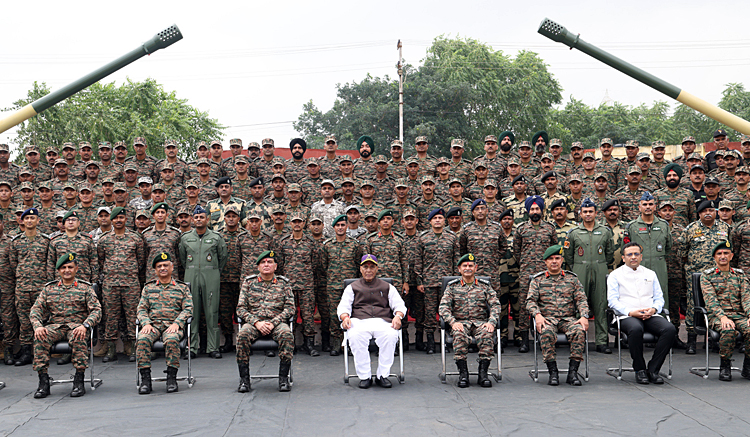
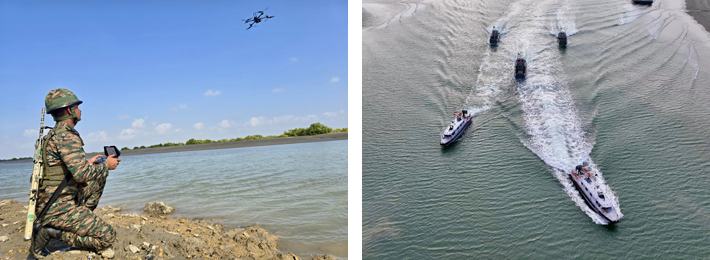
The area has witnessed heightened military activity in recent years. Defence Minister Rajnath Singh visited the sector in early October 2025 and issued a warning to Pakistan against any misadventure, saying that "The road to Karachi goes through Sir Creek." Pakistan's navy chief visited Sir Creek soon thereafter and inducted three hovercraft into the region. The shallow, marshy terrain of Sir Creek makes conventional patrols extremely difficult, limiting the effectiveness of traditional military vehicles and boats. This unique geography has compelled India to seek specialised solutions to strengthen its presence and counter Pakistan's growing activity.
The marshy, tidal terrain severely restricts conventional patrol operations, increasing the importance of hovercraft, amphibious assault boats, surveillance networks and specialised mobility solutions.
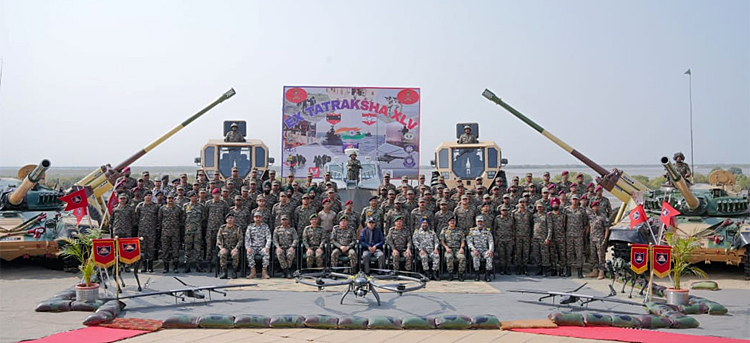
Pakistan has specifically deployed hovercrafts and specialised amphibious equipment to handle the difficult marshy, tidal terrain of Sir Creek. Specialised equipment used by Pakistan includes:
India has responded with an RFP for amphibious combat boats under the 'Buy Indian' category, aimed at improving operations in shallow waters and marshland while strengthening coastal surveillance.
India has responded by issuing a Request for Proposal (RFP) to acquire amphibious combat boats under the 'Buy Indian' category. These vessels are designed specifically for operations in shallow waters and marshland terrain. Each boat will be capable of carrying approximately 1,500 kg, including fully equipped soldiers and their gear.
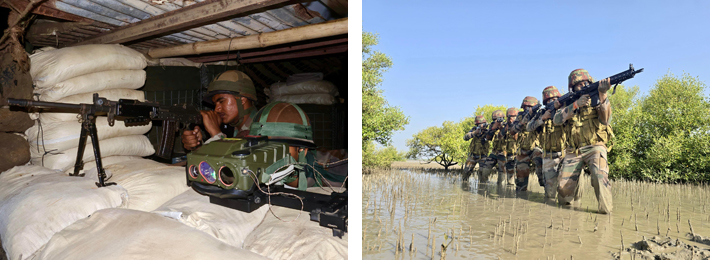
Finally, India must keep its guard up because Pakistan is supported by both China and the US, and the creek lies close to Pakistan's major naval and economic hub, Karachi. Control over this region and its bordering waters is vital for the Indian Navy and Border Security Force (BSF) to monitor naval movements and prevent maritime infiltrations. A clear boundary ensures robust coastal surveillance, mitigating threats similar to those witnessed during seaborne attack – but the boundary remains disputed.