



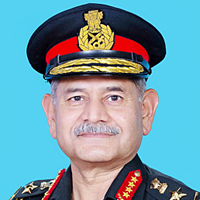
The insightful articles, inspiring narrations and analytical perspectives presented by the Editorial Team, establish an alluring connect with the reader. My compliments and best wishes to SP Guide Publications.
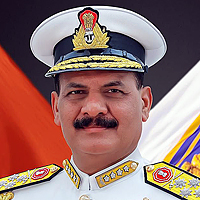
"Over the past 60 years, the growth of SP Guide Publications has mirrored the rising stature of Indian Navy. Its well-researched and informative magazines on Defence and Aerospace sector have served to shape an educated opinion of our military personnel, policy makers and the public alike. I wish SP's Publication team continued success, fair winds and following seas in all future endeavour!"

Since, its inception in 1964, SP Guide Publications has consistently demonstrated commitment to high-quality journalism in the aerospace and defence sectors, earning a well-deserved reputation as Asia's largest media house in this domain. I wish SP Guide Publications continued success in its pursuit of excellence.
Indian Army in collaboration with the Centre for Land Warfare Studies (CLAWS) organised the two-day Chanakya Defence Dialogue that unfolded under the overarching theme ‘Reform to Transform – Sashakt, Surakshit aur Viksit Bharat’ at the Manekshaw Centre in New Delhi
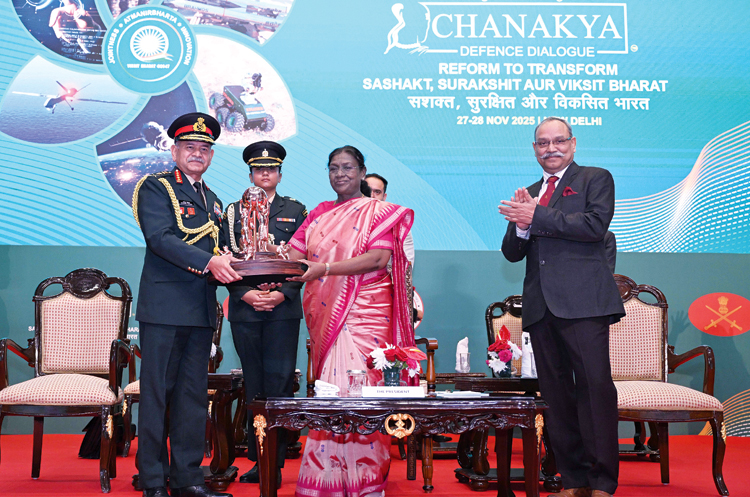
In late November 2025, the Indian Army’s Chanakya Defence Dialogue convened at the Manekshaw Centre in New Delhi for its third edition, bringing together an eminent assembly of military leaders, policymakers, global strategic thinkers, industry representatives and scholars. Organised in collaboration with the Centre for Land Warfare Studies (CLAWS), the two-day Dialogue unfolded under the overarching theme “Reform to Transform – Sashakt, Surakshit aur Viksit Bharat”, providing a rigorous platform for deliberation on defence reforms, emerging security challenges and the future contours of India’s national strategy.
From the outset, the Dialogue embodied India’s aspiration to align its defence architecture with the imperatives of a rapidly evolving global order — one marked by technological disruption, shifting power dynamics and the emergence of new domains of competition. More than a seminar, CDD 2025 sought to generate actionable insights that bridge operational experience with strategic foresight.
The Dialogue commenced with an august inaugural session graced by Droupadi Murmu, President of India, whose presence underscored the national significance of the deliberations. In her address, the President paid homage to the Indian Armed Forces, observing that their professionalism and patriotism are central to safeguarding India’s sovereignty. She lauded their adaptability across the spectrum of operations — from conventional engagements to counterinsurgency and humanitarian missions.
Reflecting on India’s recent Operation Sindoor, she remarked, “The world took note not only of India’s military capability but of India’s moral clarity to act firmly, yet responsibly, in the pursuit of peace.” This statement highlighted the fusion of ethical conduct and strategic intent that she believes must underpin India’s defence posture.
President Murmu also pointed to the transformation underway within the armed forces. “The Army is reforming structures, re-orienting doctrines and redefining capabilities to be future-ready,” she declared, emphasising the need for forces agile in new domains such as cyber, space, information and cognitive warfare. Her conviction that these reforms will contribute to self-reliance in defence underscored the event’s core theme — that transformation is both technological and institutional.
Following the President’s address, General Upendra Dwivedi, Chief of the Army Staff, delivered the Keynote Address, placing equal emphasis on strategic clarity and practical pathways for transformation. He observed that the Dialogue has matured into an “intellectual anchor” for India’s defence community since its inception, and underlined the imperative for the Army to remain decisive within an increasingly turbulent multipolar world.
General Dwivedi elaborated a structured roadmap for the Army’s transformation, aligning it with the Government of India’s strategic vision. “Guided by the Prime Minister’s 5S vision — Sammaan, Samvad, Sahayog, Samridhi and Suraksha — we are pursuing a phased transformation through HOP 2032, STEP 2037 and JUMP 2047,” he explained. This encapsulates an ambitious journey from accelerated capability creation, through consolidation, to a fully integrated, next-generation force design.
He identified four strategic drivers critical for this journey: deeper self-reliance through indigenisation, accelerated innovation in critical technologies, systemic adaptation of defence structures, and stronger military-industry-academia integration. His keynote set the tone for the thematic sessions that followed — all focused on harnessing knowledge, technology and reform to achieve future readiness.
The inaugural day featured three substantive thematic sessions, each bringing multidisciplinary perspectives to bear on contemporary challenges.
The first, titled Op SINDOOR: A Sovereign Strategic Victory, examined India’s evolving deterrence strategy and the lessons emerging from recent operations. Though anchored in operational insight, the session shifted rapidly into broader strategic reflections — including normative questions on the use of force, ethical considerations in conflict, and implications for deterrence in the Indo-Pacific context.
The second session, Changing Status Quo: Vitalising Defence Reforms, took on the ongoing reform agenda within India’s defence establishments. Here, speakers from the government and defence ecosystem articulated the necessity of policy reforms that unlock innovation, enhance acquisition agility and create an enabling industrial base. Discussions also mapped pathways to integrate private sector R&D with national priorities, particularly as technology cycles compress and global competition intensifies.
The third session, Civil–Military Fusion: Drivers for Change, focused on synchronising military needs with civilian technological prowess. Delegates underscored that breakthroughs in artificial intelligence, quantum computing, autonomy and sensor networks will decisively shape strategic advantage going forward. The session concluded with a consensus that India’s defence ecosystem must nurture collaborative models that accelerate cross-domain innovation.
The second day shifted emphasis to high-level policy guidance and strategic forecasting. Defence Minister Rajnath Singh delivered a defining address on defence reforms as a strategic necessity. He described the Dialogue as a forum where operational experience merges with strategic thought to yield future-ready policies.
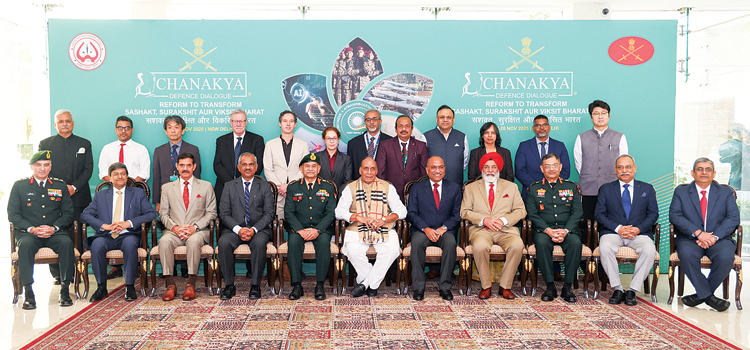
The Defence Minister noted that reforms are critical amid “shifting global power centres, blurred boundaries between peace and conflict, and expanding domains of warfare including cyber, space, information and cognitive influence.” He stressed that India’s growing global role is driven by its economic strength, technological capability and principled foreign policy.
In outlining government priorities, he emphasised capability enhancement, infrastructure development, technology adoption, Atmanirbhar Bharat and the wellbeing of soldiers and veterans. “A strong, secure and developed India contributes to global stability, ethical use of emerging technologies and humanitarian values,” he declared, reaffirming India’s commitment to responsible leadership in defence and security.
Complementing the Defence Minister’s address, Ambassador D.B. Venkatesh Verma, Member of the National Security Advisory Board, delivered a compelling perspective on Resilient National Security @2047. He articulated strategic autonomy not as a slogan, but as the capacity “to think, act and fight independently without allowing external engagements to turn into vulnerabilities.” His reflections tied defence readiness to societal confidence, economic resilience and technological autonomy — all seen as cornerstones of long-term strategic strength.
The Dialogue concluded with the Closing Address by Lt General Pushpendra Pal Singh, Vice Chief of the Army Staff, who reflected on the insights generated over the two days. He reiterated that India’s security environment demands forces that are agile, technologically empowered and operationally integrated. His message affirmed that the deliberations — ranging from emerging technologies and battlefield equalisation to jointness, innovation and reforms — would inform the Indian Army’s transformation roadmap for years to come.
Across its two days, the Chanakya Defence Dialogue 2025 emerged as an authoritative platform for shaping India’s future defence posture. The event consistently emphasised that self-reliance, technological excellence and integrated national strategy are indispensable to realising the goal of a Sashakt, Surakshit aur Viksit Bharat by 2047.
The dialogues and addresses — whether from the President, the Defence Minister, the Army Chief or eminent strategists — reflected a common conviction: that India’s defence transformation must be future-ready, ethically grounded, and woven into the broader fabric of national growth and resilience. This seminar was not merely a reflection but a blueprint — one that binds strategic vision with institutional reform, innovation with operational readiness, and national aspiration with global responsibility.