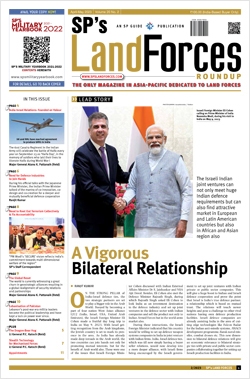





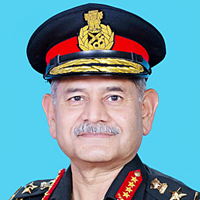
The insightful articles, inspiring narrations and analytical perspectives presented by the Editorial Team, establish an alluring connect with the reader. My compliments and best wishes to SP Guide Publications.
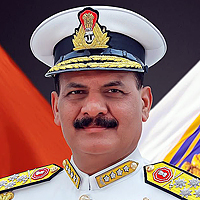
"Over the past 60 years, the growth of SP Guide Publications has mirrored the rising stature of Indian Navy. Its well-researched and informative magazines on Defence and Aerospace sector have served to shape an educated opinion of our military personnel, policy makers and the public alike. I wish SP's Publication team continued success, fair winds and following seas in all future endeavour!"

Since, its inception in 1964, SP Guide Publications has consistently demonstrated commitment to high-quality journalism in the aerospace and defence sectors, earning a well-deserved reputation as Asia's largest media house in this domain. I wish SP Guide Publications continued success in its pursuit of excellence.
The Future Ready Combat Vehicle programme is intended to replace the Indian Army’s ageing tank fleet with a modular, digitally connected main battle tank
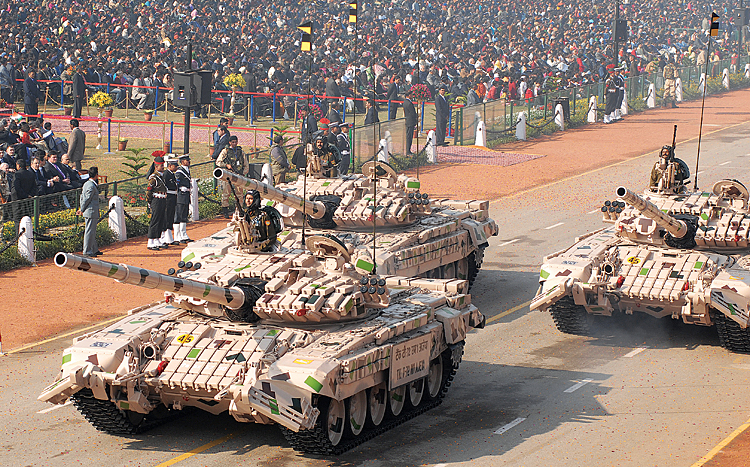
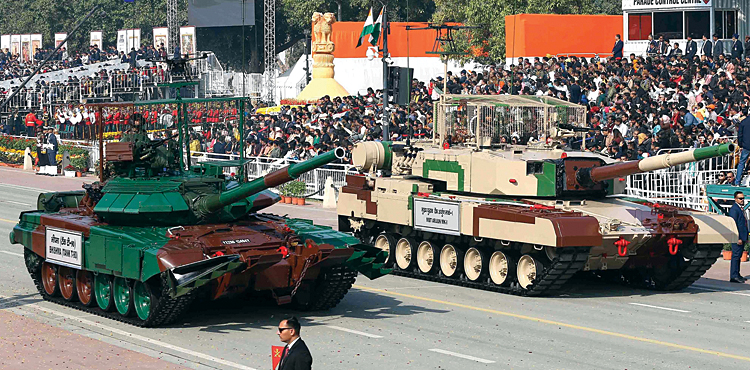
The Indian Army’s Future Ready Combat Vehicle (FRCV) programme is one of the most consequential land-systems acquisition initiatives in its modernisation pipeline. Conceived as the eventual successor to the T-72 main battle tank fleet, the FRCV is expected to do more than replace an ageing platform. It is intended to provide the Army with a technologically advanced, adaptable combat vehicle capable of remaining operationally relevant well beyond 2050.
The scale of the requirement is significant. The Army’s 2021 Request for Information (RFI) envisaged approximately 1,770 tanks, to be inducted in phases. The proposed vehicle would have to operate across India’s varied operational environments, from deserts and plains to riverine areas and high-altitude terrain. Its expected service life of 40–50 years places a premium on modularity, upgradeability and the ability to accommodate technologies that may not yet be fully mature.
The programme has moved through important approval and industrial-planning milestones, but the distance between an approved requirement and an inducted tank remains considerable. The immediate task is to establish a workable development partnership, bring critical technologies together and create a realistic path through design, prototyping, evaluation, production and induction.
The Army’s May 2021 RFI initially envisaged the Strategic Partnership route under the Defence Acquisition Procedure 2020. Under this approach, an Indian strategic partner would collaborate with a foreign original equipment manufacturer (OEM), combining overseas technology and experience with domestic manufacturing, integration and long-term support. The objective was to build an indigenous industrial capability rather than rely on the purchase of a finished foreign platform.
A major milestone came in September 2024, when the Defence Acquisition Council (DAC) accorded Acceptance of Necessity (AoN) for the FRCV. The approval formed part of a package of capital acquisition proposals valued at ₹1,44,716 crore. The Ministry of Defence described the proposed tank as having superior mobility, all-terrain capability, multilayered protection, precision and lethal firepower, and real-time situational awareness.
The AoN was an important step in the acquisition process, but it was not a development contract or a production order. Greater detail on the proposed industrial route emerged in 2025. Armoured Vehicles Nigam Limited (AVNL) issued an Expression of Interest (EoI) in April seeking technology partner(s) and OEMs for the FRCV under the Make-I category. BEML had issued a separate EoI in March 2025 seeking technology collaboration for the programme.
The AVNL EoI retained the overall requirement of 1,770 vehicles, divided into three phases of 590 each, with the first phase identified as a firm requirement. A phased acquisition could allow later production lots to incorporate validated improvements in sensors, protection, weapons and electronics. It would also offer industry a more predictable production horizon, provided the Army and procurement agencies establish a stable baseline configuration and a credible schedule.
The technical parameters outlined in the AVNL document indicate the scale of the engineering challenge. The proposed tank is to have a four-member crew and a combat weight of approximately 55 tonnes, with a stated tolerance of five per cent. It is to be powered by an engine of at least 1,500 hp, delivering a power-to-weight ratio of not less than 27 hp per tonne. The primary armament requirement is a minimum 120mm gun, supported by a coaxial 7.62mm machine gun and a 12.7mm remotely controlled weapon system.
The requirement also points towards missile-firing capability and the integration of loitering munitions. These features reflect the changing character of armoured warfare, in which tanks must contend not only with opposing armour and anti-tank weapons but also with persistent surveillance, precision strikes and increasingly capable unmanned systems.
The Future Ready Combat Vehicle (FRCV) programme is not simply a replacement plan, but an opportunity to develop a modular, digitally connected armoured platform designed to remain operationally relevant for the next four to five decades
The FRCV is consequently expected to be more than a conventional tank with improved armour and a larger gun. The desired capability set includes automatic target detection and tracking, hunter-killer functions, 360-degree situational awareness, digital battlefield management and friend-or-foe identification. Integration with intelligence, surveillance and reconnaissance systems, electronic warfare resilience, missile warning and active protection are also central to the intended capability.
The vehicle will need to operate as part of a connected combat formation, sharing information with other manned and unmanned platforms. Such integration will depend on secure communications, reliable computing architecture and sensors capable of functioning in demanding battlefield conditions. The ability to detect, classify and engage threats rapidly will be as important as the tank’s traditional combination of firepower, protection and mobility.
The engineering challenge lies in making these systems work together without compromising reliability, maintainability or operational availability. Engine and transmission performance, thermal management, suspension, armour, fire control, ammunition handling and electronic architecture must be validated as an integrated whole. Indigenous manufacture of the hull and turret alone will not deliver technological sovereignty if the power pack, transmission, sights, sensors or other high-value subsystems remain dependent on external suppliers.
The FRCV is likely to shape India’s armoured-vehicle industrial landscape for years. AVNL and BEML have taken formal steps to explore technology partnerships, while major private-sector manufacturers have publicly indicated their interest in the opportunity. The programme calls for a combination of design and systems-engineering capability, heavy manufacturing infrastructure, access to specialist technologies and the capacity to sustain a complex platform over several decades.
Larsen & Toubro (L&T) has been particularly clear about its interest. The company identified FRCV as one of the major Army programmes for which it was preparing. It highlighted its Armoured Systems Complex at Hazira, along with its engineering, manufacturing, integration and testing capabilities. L&T also pointed to its experience in executing the K9 Vajra-T self-propelled howitzer programme and its readiness to work with global OEMs on domestic manufacturing and technology absorption.
The company’s collaboration with DRDO on the Zorawar Indian Light Tank provides a further example of its tracked-vehicle development capability. The 25-tonne Zorawar is a separate light-tank programme, designed for a different operational requirement, and must not be confused with an FRCV prototype. Nevertheless, the work demonstrates experience in bringing together a defence research organisation and a private manufacturer to develop a complete tracked platform.
Tata and Mahindra are also part of the wider private-sector industrial base that could contribute to the programme. Their experience in engineering, vehicle manufacturing and defence production provides a potential foundation for participation, depending on the final procurement and partnership structure. The precise roles of individual companies will become clearer only when the acquisition process advances and the government identifies the development arrangement.
For India, the industrial objective should extend beyond assembling a tank under licence. The development model must create domestic design authority, systems-integration expertise, a resilient supplier ecosystem and the ability to upgrade the platform throughout its service life. Foreign collaboration may be essential for certain technologies, but it should be structured to deliver meaningful technology absorption and progressively greater indigenous control.
The FRCV must benefit from the experiences of other development programmes and ensure early alignment between the Army, design agencies, production partners and suppliers. Requirements should be sufficiently demanding to deliver the desired operational advantage, but also stable enough to permit engineering development and meaningful trials. Changes to the baseline during development can have substantial consequences for cost, schedule and system integration.
The programme’s modular ambition is particularly important. A common platform architecture could support future upgrades and potentially provide the basis for specialised variants, including recovery and engineering vehicles. A planned family of vehicles could improve commonality in training, maintenance and logistics. Such possibilities, however, should be balanced against the need to avoid overloading the initial tank design with requirements that delay its development.
The next phase will require decisions on the development model, the selection of technology partners and the allocation of design authority, intellectual property and production responsibilities. A detailed schedule must cover design freeze, prototype construction, technical evaluation, user trials, acceptance, production preparation and phased induction. Funding and testing infrastructure must be aligned with these milestones.
Particular attention will have to be paid to the power pack and transmission. These are among the most demanding elements of a modern tank and have implications for mobility, reliability, maintenance and performance in extreme climates. Similar care will be required in the development or integration of active protection, fire-control systems, thermal sights, electronic architecture and advanced armour. A credible indigenous content strategy should identify which technologies can be developed domestically, which require collaboration and how dependence on imported components will be reduced over time.
The FRCV programme represents one of India’s most significant future armouredvehicle opportunities. The challenge lies in translating the Army’s ambitious technical requirements into a validated platform, a robust domestic industrial ecosystem and a credible induction schedule.
The Army will also need a disciplined approach to trials. The FRCV must undergo rigorous technical and user validation, particularly in areas affecting crew safety, reliability, protection and performance across varied terrain. At the same time, evaluation procedures should be predictable, with clearly defined criteria and timelines. Industry must have sufficient clarity to justify investment in prototypes, specialist facilities and supply chains.
The phased requirement of 1,770 tanks offers an opportunity to establish a stable production pipeline. Long gaps between orders can undermine investment in manufacturing capacity and specialist skills. A structured batch approach, with improvements introduced after validation, could support continuity while ensuring that the tank evolves as technology and operational requirements change.
Ultimately, the FRCV will be judged not by the ambition of its specifications or the number of companies expressing interest, but by the Army’s ability to field a reliable and capable tank in meaningful numbers. The T-72 replacement requirement cannot remain indefinitely at the stage of approvals and expressions of interest. India has developed a stronger defence industrial base and accumulated valuable experience in armouredplatform development. The task now is to bring those capabilities together in a programme that delivers a future-ready combat vehicle—and does so within a credible timeframe.