




The insightful articles, inspiring narrations and analytical perspectives presented by the Editorial Team, establish an alluring connect with the reader. My compliments and best wishes to SP Guide Publications.
"Over the past 60 years, the growth of SP Guide Publications has mirrored the rising stature of Indian Navy. Its well-researched and informative magazines on Defence and Aerospace sector have served to shape an educated opinion of our military personnel, policy makers and the public alike. I wish SP's Publication team continued success, fair winds and following seas in all future endeavour!"

Since, its inception in 1964, SP Guide Publications has consistently demonstrated commitment to high-quality journalism in the aerospace and defence sectors, earning a well-deserved reputation as Asia's largest media house in this domain. I wish SP Guide Publications continued success in its pursuit of excellence.
As Washington, Beijing and Moscow manoeuvre for strategic advantage, the global balance of power is shifting. The recent APEC and QUAD summits, alongside the trilateral meeting of the US, China and Russia, expose the growing disconnect between geopolitical posturing and substantive global leadership.
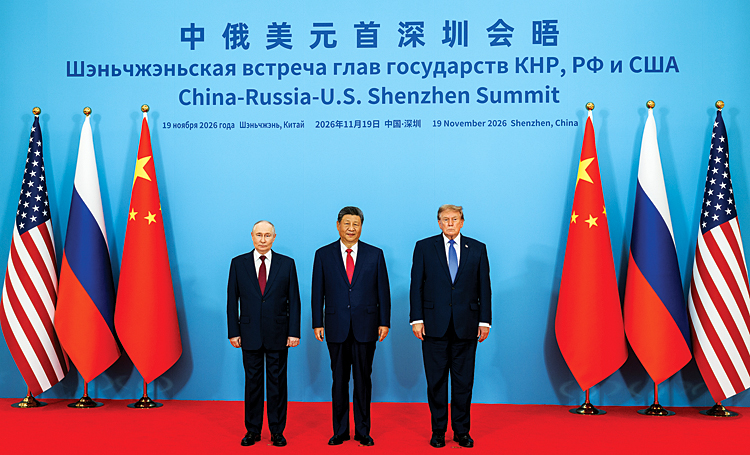
President Donald Trump, President Xi Jinping, and President Vladimir Putin sat down together in Shenzhen, China during the Asia-Pacific Economic Cooperation (APEC) conference on November 19, 2026 for the first trilateral summit between the leaders of the US, China, and Russia. Trump called the three “uniquely positioned” to tackle the globe’s most difficult issues, including the reduction of the world’s nuclear arsenals. A Yalta 2.0, the optics suggested. Really?
The Yalta Conference took place in the Russian resort town in the Crimea from February 4–11, 1945, during World War II. At Yalta, US President Franklin Roosevelt, British Prime Minister Winston Churchill and Soviet Premier Joseph Stalin met to plan the final defeat and occupation of Nazi Germany. The Allied leaders also discussed the future of Eastern Europe, the United Nations and the post-war world.
It surely was about the loss of American hegemony and its dwindling grip over global security and leadership
Yalta was a meeting of the three chief Allied leaders focused on a common enemy, the Axis powers - Nazi Germany, Italy and Japan. Who is the enemy these three leaders discussed about in Shenzhen? What are the globe’s most difficult issues that Trump was alluding to?
Well, the world is experiencing more active wars than at any point since World War II. Wars are more widespread, more persistent and deadlier than in recent decades, driving unprecedented humanitarian fallout. The war in Ukraine is in its fifth year, instigated by US staged Maidan revolution of 2014 which led to Russia annexing Crimea (paradoxically the site for the 1945 Yalta conference) and culminating in all-out war since February 2022. Russian assets to the tune of $300 billion have been frozen by the US and its European allies and unprecedented sanctions imposed. Essentially it’s a NATO vs Russia war with Ukraine as the battleground. China has come closer to Russia since and is speculated to assist Russia in the war effort including off-taking huge Russian crude sanctioned by the west. So who was playing the referee in the trilateral?
Another February, and another war opens up. On February 28, 2026, US missiles struck multiple sites across Iran in tandem with Israeli aerial offensive. A missile struck a girls’ school located in the city of Minab, southern Iran, killing more than 150 schoolgirls, the Ayatollah was killed as were multiple other IRGC generals since. The US continues to target Iranian nuclear facilities, hugely escalating chances of a radiation fallout that can seriously engulf the entire region. In retaliation, Iran has struck the Dimona nuclear reactor site in Israel and caused extensive destruction to US bases and air defence sites spread across its GCC allies including Saudi Arabia, Kuwait, UAE, Bahrain, Qatar and Jordan. Iran has effectively shut down the Strait of Hormuz, through which nearly one-fifth of global crude and a large portion of LNG trade flows. In concert with Iran, Houthis have disrupted shipping through the Bab al-Mandeb strait sniffing out another 7 per cent of global oil flows.
Iran war linked cost of living issues were the biggest factor in Trump’s Republican party getting thrashed in the November 3, 2026 mid-term elections. The US alleges that Russia and China are actively assisting the Iran war efforts, through supply of missiles, drones and satellite intelligence for targeting. So who was playing the referee in the trilateral to see an end to the war in the Middle East?
The trilateral is yet another showmanship of transaction-driven Trump diplomacy like the Board of Peace (BoP). India rightly weighed legitimacy, UN bypass risks, Pakistan’s presence and long-term implications and stayed away from the Sharm El-Sheikh Peace Summit, Egypt held on October 13, 2025. Comically, the affected parties, Gaza and Israel were missing from the table that was deliberating over their future. It has been over one year since Trump’s BoP brokered a “ceasefire” aimed at eventually ending Israel’s war in Gaza. However, the war has only expanded, with the February 2026 US-Israel bombing of Iran, snaring the entire Middle East.
Energy fuelled inflation and fertiliser shortages along with disruptions in global supply chains are causing widespread internal disturbance across the globe including Europe. But the poorest countries are impacted the most. Hunger is becoming deeper, deadlier and more concentrated in crisis-affected countries. Thirty-seven million people are now facing emergency levels of food insecurity where families face extreme food gaps, very high malnutrition and rising deaths. Four out of five people displaced globally (80 per cent) were uprooted by conflicts, violence or persecution, with the number of displaced people estimated at 117.3 million in 2025.
Natural shocks like flooding and droughts are increasing in both frequency and severity. Yet, support for people living through the climate crisis is limited, with only a tiny fraction of climate funding going to climate adaptation programmes. Trump has repeatedly called climate change a “hoax”. So what did he bring to the table in the trilateral?
It also signalled that Europe should recalibrate its relations with neighbour Russia and the joyride with the US maybe over
As regards reductions in nuclear arms, the US has reneged on international treaties on missiles and nuclear testing, particularly the Comprehensive Nuclear-Test-Ban Treaty (CTBT) ratified by the UN in 1996. The US withdrew from the Anti-Ballistic Missile Treaty in 2002. Even though the US certified in April 2017 and in July 2017 that Iran was complying with the JCPOA, on May 8, 2018, Trump unilaterally withdrew from the deal. Now the US and Russia have both recently threatened to resume nuclear testing. China will benefit the most if testing resumes unhindered. However, the joint declaration sets no timetable or agenda and contains no commitment to negotiate limits on arsenals.
Optics took precedence over substance. There is the long-simmering issue of Taiwan which places the US and China at opposite ends but simply wasn’t on the menu. The so-called joint statement left out the most important questions, such as Ukraine and Iran. With the fallout from the Nvidia affair and the midterms causing a recalibration in US strategy vis-à-vis China, Xi could ramp up rareearth or other supply-chain restrictions in response to stricter enforcement of US chip controls. The trilateral is no sign of thaw.
Trump relished the red carpet welcome with Xi personally present at the airport (just returning a favour since Trump extended the gesture during his visit to Washington DC on September 23, 2026). Xi at the head of the trilateral signalled he is the new Sheriff in town. Putin got what he wanted: a photo of himself alone with the leaders of the world’s two genuine superpowers, the US and China. That image validated Russia as a great power and him as a global leader. Along with the family photo with twenty other leaders, it graphically underscored that the Europeans’ effort to isolate Russia diplomatically had failed. Europe was not on the table; Europe was on the menu!
In essence, unlike Yalta, the Shenzhen trilateral was a meeting of adversaries and not allies. If it signalled anything, it surely was about the loss of American hegemony and its dwindling grip over global security and leadership. It also signalled that Europe should recalibrate its relations with neighbour Russia and the joyride with the US maybe over.
India is not a member of the APEC, therefore, not present in Shenzhen and was not invited for any discussions that might have happened as a prelude to the trilateral. Is it a smack on India’s standing in the global order? Well, let’s remind ourselves that as of 2026, India’s GDP per capita is projected to be $2,813, ranking 149th among 195 countries globally. We must continue to focus on growth and not get swayed by power play at the global table. We have a long way to go.
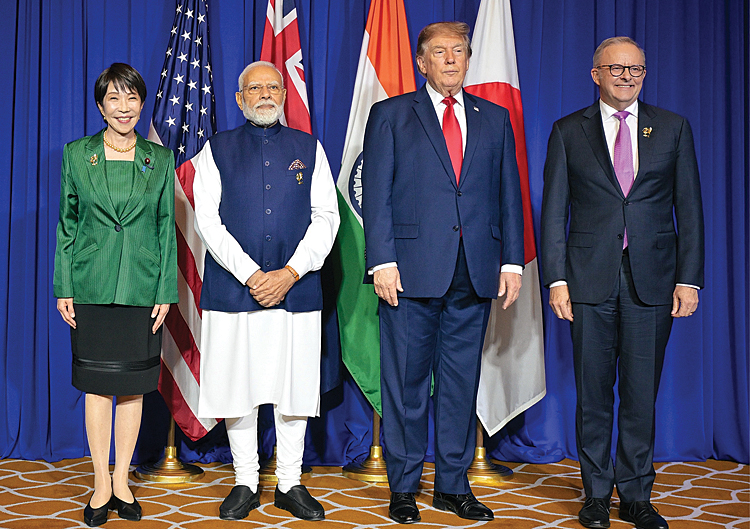
Two days before the trilateral meeting in Shenzhen, the QUAD (the US, Australia, India, and Japan) leaders met in Manila for the first time since September 2024 on the side-lines of the 49th ASEAN summit. For a US-led grouping that was once projected as a counterweight to China’s growing influence in the Indo-Pacific, sparing just 55 minutes is hardly reassuring, especially compared to the 105 minutes Trump-Xi bilateral before the trilateral. Prior to the summit, China had warned against internationalising the South China Sea dispute. The outcome, therefore, was diffused, centred on peripheral issues such as counterterrorism cooperation, the Indo-Pacific Maritime Surveillance Collaboration, an expanded cable partnership, and enhanced cyber security cooperation. The QUAD is not a treaty-based military alliance and the outcome shouldn’t surprise security experts in India.
The G20 summit is set for December 14-15, 2026, at Trump’s Doral resort in Miami, and Xi is expected to attend. Putin has been invited, but it is unclear whether he will attend. This is the next opportunity for the trio to build on anything they established during the Shenzhen talks. Anything at all?