




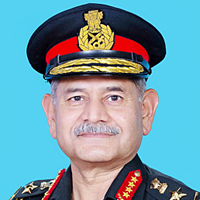
The insightful articles, inspiring narrations and analytical perspectives presented by the Editorial Team, establish an alluring connect with the reader. My compliments and best wishes to SP Guide Publications.
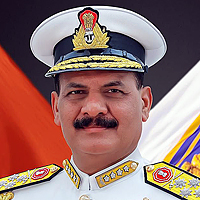
"Over the past 60 years, the growth of SP Guide Publications has mirrored the rising stature of Indian Navy. Its well-researched and informative magazines on Defence and Aerospace sector have served to shape an educated opinion of our military personnel, policy makers and the public alike. I wish SP's Publication team continued success, fair winds and following seas in all future endeavour!"

Since, its inception in 1964, SP Guide Publications has consistently demonstrated commitment to high-quality journalism in the aerospace and defence sectors, earning a well-deserved reputation as Asia's largest media house in this domain. I wish SP Guide Publications continued success in its pursuit of excellence.
The 3rd International Seminar on Artillery Technology highlighted the latest technological developments in artillery and the need to take advantage of available new technologies for the modernisation of Indian Artillery
The Regiment of Artillery in association with the Confederation of Indian Industry (CII), the Defence Research and Development Organisation (DRDO), and CLAWS jointly organised a two-day International Artillery Seminar on May 10 and 11 at the India Habitat Centre in New Delhi. International defence companies such as BAE Systems, General Electric, Israeli Aerospace Industries, Lockheed Martin, Raytheon, SAAB Group, Sagem (Safran Group) and Nexter took part in the event along with Indian companies like Tata Power, Tata Motors, Bharat Electronics, Indian Ordnance Factories, and the Armament Research and Development Establishment of DRDO.
The main aim of the seminar was to discuss the latest technological developments in artillery in order to take advantage of available new technologies for the modernisation of Indian Artillery. The seminar covered all aspects regarding the modernisation of Indian Artillery platforms and support systems. The seminar comprised three technical sessions, apart from the inaugural and valedictory sessions. The technical sessions deliberated on the development of weapons systems and munitions, measures to enhance surveillance and targeting and research, and industry’s capability to meet future challenges. The highlights of the seminar along with Editors Comments are given in the subsequent paragraphs.
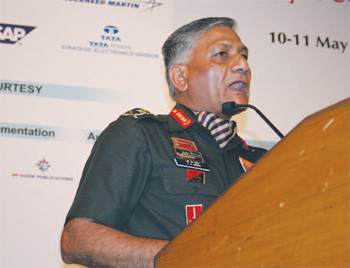
Army Chief General V.K. Singh, in his keynote address, said that India has been “too late” in acquiring modern artillery and needs to accelerate its efforts to modernise its firepower in an era where advanced nations have gone far ahead. General V.K. Singh, who assumed office on March 31, said that though Indian artillery is in the process of a major modernisation programme, the induction of more powerful weapons like 155mm/52 callibre guns of the wheeled and self-propelled variety as also the ultra light guns is not proceeding at the desired pace.
He stressed that it is imperative that India systematically modernises its artillery to compete with the best in the world. The Army Chief cautioned that any delay in this regard would render the gap between the front-runners and laggards impossible to be narrowed down. “We certainly need to catch up, and catch up fast. We have to take much longer strides and accelerate our efforts,” he added.
Lt. General K.R. Rao, Director General, Regiment of Artillery, said that for the next 15-20 years, the philosophy of artillery should continue to achieve “destruction” by synergised orchestration of all available firepower resources provided by a variety of agencies cutting across the three services based on a joint targeting doctrine, including effective use of the ‘fourth dimension’. Regarding the future, Lt General Rao said, “Futuristic artillery platforms should be independent and autonomous firing identities, capable of firing on their own, achieved by introducing automatic alignment, and laying and loading of ammunition. These platforms should have matching mobility in case of towed guns, adequate protection in case of self-propelled guns and portability by helicopters and aircrafts in case of light guns. Large operational frontages will dictate platforms capable of achieving longer ranges, which help us in achieving concentrated firepower in preference to concentrating firepower units. However, there should be a balance between mobility and longer range.”
He also stressed on the importance of efficient ammunition management in the field, which becomes a crucial battle winning factor rather than merely the number of tubes (guns) available.
Brigadier Gurmeet Kanwal, Director, CLAWS felt that there was an 80-90 per cent chance that future conflicts, if any, would break out in the mountains as a corollary of the ongoing border disputes. He felt that gaining and occupying territory and evicting the enemy from the territory occupied by them are important military objectives in future wars and only an air land battle with massive asymmetry of firepower in our favour would achieve the desired military objectives.
He felt that manoeuvres are limited in mountains and deep manoeuvres in the plains and deserts cannot be risked due to the nuclear overhang and, hence, limited wars will have “limited aims and objectives, limited force levels, limited geographical area, and limited timeframe.” He therefore, gave three trend lines for artillery firepower in the future - change in employment of artillery from neutralisation to destruction; from dumb to smart and intelligent munitions; from long-drawn ranging procedures to near first salvo effectiveness. He recommended heavy accretion of artillery and use of precision-guided munitions from the current negligible levels to 20 per cent of total available ammunition.
Dr Bashir from Tata Power (Strategic Electronics Division) said that the requirements of modern artillery include characteristics such as higher lethality, enhanced range consistency, all-weather operations, battlefield management, survivability, crew comfort and auto operation, better accuracy with response time, and shoot and scoot capability. He said that there are many contributing elements which involve the development of fast response technological configurations. He then proceeded to explain how these could be acquired. He also explained the work done by Tata Power in upgrading the L-70 air defence gun.
Colonel R.S. Athreye made an interesting presentation on ‘Enhancing lethality and precision’. He spoke in detail about the factors and technologies involved in development of trajectory correctable munitions and terminally-guided munitions.
Lt General V.K. Ahluwalia, General Officer Commanding-in-Chief, Central Command, in a special address before the start of Session II, made a very informative presentation on ‘Artillery in mountains, high altitude and glaciated terrain’. He explained the terrain peculiarities and the impact of these on artillery fire. He quoted from Lt General V.R. Raghavan’s book about the fact that artillery exchange is an economic form of fighting in the Siachen region. Having been GOC 14 Corps in the very same region earlier, it was interesting to hear his views on the employment of artillery in this geographical zone.