
INDIAN ARMED FORCES CHIEFS ON OUR RELENTLESS AND FOCUSED PUBLISHING EFFORTS

The insightful articles, inspiring narrations and analytical perspectives presented by the Editorial Team, establish an alluring connect with the reader. My compliments and best wishes to SP Guide Publications.

"Over the past 60 years, the growth of SP Guide Publications has mirrored the rising stature of Indian Navy. Its well-researched and informative magazines on Defence and Aerospace sector have served to shape an educated opinion of our military personnel, policy makers and the public alike. I wish SP's Publication team continued success, fair winds and following seas in all future endeavour!"

Since, its inception in 1964, SP Guide Publications has consistently demonstrated commitment to high-quality journalism in the aerospace and defence sectors, earning a well-deserved reputation as Asia's largest media house in this domain. I wish SP Guide Publications continued success in its pursuit of excellence.


- All about HAMMER Smart Precision Guided Weapon in India — “BEL-Safran Collaboration”
- US to sell $93 million precision artillery, Javelin and Excalibur projectiles to India
- US to sell $93 million precision artillery, Javelin and Excalibur projectiles to India
- India, Germany deepen defence ties as High Defence Committee charts ambitious plan
- True strategic autonomy will come only when our code is as indigenous as our hardware: Rajnath Singh
- India-Israel Joint Working Group Meeting on defence cooperation to boost technology sharing and co-development
- G20 Summit: A Sign of Global Fracture
The Trend is for FMS Route
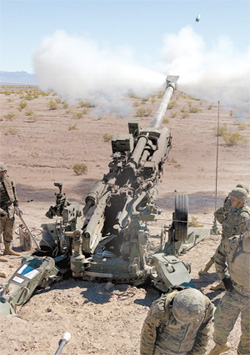
India has carried out wide-ranging reforms in its procurement organisation and procedures. Free competition and transparency are central to the new dispensation. But many observers fear that a distinct discernible pattern is emerging in recent deals to circumvent competition.
On January 22 this year, the Defense Security Cooperation Agency (DSCA) of the US notified the US Congress of a possible foreign military sale (FMS) of 145 M777 155mm light-weight towed howitzers with laser inertial artillery pointing systems for approximately $647 million (Rs 3,039 crore) to India. It was also clarified that the deal would carry no offset obligations.
The news report came as a surprise to many observers. Earlier reports had indicated that India would be procuring light howitzers in an open competition after techno-commercial evaluation of all howitzers on offer. Having failed to conclude any major contract in multi-vendor environment during the last decade, it appears that the government has lost confidence in its own procurement regime. For all urgent and critical equipment, it has been resorting to single-vendor procurements.
In a path-breaking deal with the US, purchase of 8 AN/TPQ-37 Fire Finder counterbattery artillery radars was negotiated in 2002. India wanted a vast array of latest military equipment and the US authorities appeared receptive. Purchase of P-8I maritime patrol aircraft (DCS deal) and C-130J Super Hercules transport aircraft are some of the other major deals signed.
Foreign military sales
Military equipment is sold by the US in two ways–direct commercial sales (DCS) and foreign military sales (FMS). Deals under DCS are pure commercial transactions between a buyer government and industry. US companies compete with producers from other counties to sell their products. As in an open global competition, all vendors are invited to field their equipment. Techno-commercial evaluation is carried out by the purchasing country as per the criteria laid down by it. It implies that the US companies are pitted against other producers and required to win contracts in a competitive environment.
FMS, on the other hand, is commonly known as a government-to-government deal. This route is usually followed for items which have already been inducted in the US forces. The buyer nation forwards a letter of request (LOR) to the US government. If the request is cleared, a letter of offer (LOO) is sent to the requesting government. The buying government is required to submit a letter of acceptance (LOA) along with the initial advance. Thereafter, a legal contract is signed. The US government may supply the item from its own existing stocks or procure it afresh from the producer.
Sale of certain critical items is allowed only through FMS route and such items are designated as “FMS only” under the provisions of the Security Assistance Management Manual (SAMM) C4.5.9. Such designation may be based on legislation, presidential policy, disclosure policy, interoperability concerns, or safety concerns. Historically, items like man portable air defence missiles, certain cryptographic equipment, precise positioning service and airborne early warning and control systems have been designated likewise.
There are no middlemen in FMS. The buyer nation saves considerable effort as the US government procures the item as per its well-established acquisition procedure. Quality and performance parameters are also assured. Since the item is already in use with its forces, the US government is in a better position to provide logistic, training and exploitation support. Joint training and development of usage doctrine also gets facilitated. FMS route is ideally suited for US allies who have common operational doctrine and where interoperability of equipment is an essential consideration.
One of the major limitations of the FMS route is that a buyer country has to accept the equipment as it exists and cannot evolve its own parameters. Unquestionably, the equipment would have been developed specifically for the US forces, keeping in mind their capabilities, doctrine and envisaged operational exploitation. It is essential for a buyer country to be fully convinced of the usefulness of the equipment in its own environmental context prior to initiating request. No military equipment is ever used in isolation and its optimum exploitation is possible only if it is fully integrated with matching capabilities.
Common misconceptions about FMS route
While the FMS route has the advantages of fixed prices, sovereign guarantees and aftersales support, it precludes competition and trials. In other words, it is a take-it-or-leave-it situation for the buyer. Some of the commonly touted advantages of FMS are examined hereunder to remove misconceptions.
It is always a cost-effective route: Although the US government offers equipment to foreign governments at the rate at which these items had been purchased for the US forces, it imposes additional handling charges. Except for specific statutory exemptions, the US government charges the purchaser for sales negotiations, case implementation, contract negotiation, contract management, financial management and allied expenses. In other words, the final FMS price includes administrative surcharge and contract administration services costs.
Moreover, the FMS system provides for estimated prices and estimated payment schedules. The final price of equipment under FMS is known only after it is delivered, whereas in open bidding, a purchaser knows the final price and payment schedule before he places orders. Additionally, the Arms Export Control Act (AECA) requires a charge for a proportionate amount of any nonrecurring costs of research, development and production of major defence equipment sold through FMS. DCS is exempt from these costs.
SP's Land Forces - CURRENT ISSUE