





The insightful articles, inspiring narrations and analytical perspectives presented by the Editorial Team, establish an alluring connect with the reader. My compliments and best wishes to SP Guide Publications.

"Over the past 60 years, the growth of SP Guide Publications has mirrored the rising stature of Indian Navy. Its well-researched and informative magazines on Defence and Aerospace sector have served to shape an educated opinion of our military personnel, policy makers and the public alike. I wish SP's Publication team continued success, fair winds and following seas in all future endeavour!"

Since, its inception in 1964, SP Guide Publications has consistently demonstrated commitment to high-quality journalism in the aerospace and defence sectors, earning a well-deserved reputation as Asia's largest media house in this domain. I wish SP Guide Publications continued success in its pursuit of excellence.
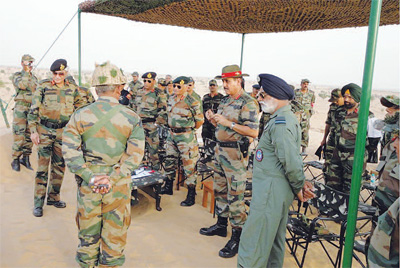
The exercise Yodha Shakti proved that the Indian Army still feels that there is a window of opportunity for a conventional conflict in the Indo-Pak context despite the latter’s repeated attempts to advance the core belief of their nuclear doctrine which precludes the possibility of a conventional conflict
Exercise Yodha Shakti held in April-May 2010, involved the Indian Army’s Mathura based 1 Corps (Strike Corps) under the command of Lt General A.K. Singh, a cavalry officer of impeccable credentials. The exercise was carried out under the aegis of Army’s South Western Command currently commanded by Lt General C.K.S. Sabu, a competent senior officer with a highly developed sense of operational art.
Collective training season
The Indian Army usually conducts exercises with troops in the Western theatre (plains, semi-desert and desert terrain) during the period from October of the previous year to April of the ensuing year in what is euphemistically known as the “campaigning season.” The period is appropriately chosen after the end of rainy season till the onset of summers. Both the offensive and defensive formations undergo training with the troops. Exercise Yodha Shakti was conducted in the desert sector for which the troops had moved out in October/November 2009 and the training was conducted from the sub-unit (infantry company or equivalent level) to higher formation level (division and corps). Apart from giving a feel of their respective commands to the commander at each level, which is an essential ingredient of training in an offensive corps, this training also ensured synergised and integrated training of all arms and services and representative employment of force multipliers, mainly to try out the intelligence, surveillance and reconnaissance equipment. This exercise also enabled the Army formations to practice joint operations with the Indian Air Force.
This training exercise was conducted in the backdrop of a conventional conflict under a nuclear shadow and, hence, was designed to achieve strategic objectives in a short timeframe. Thus, the concept of operations conceived involved simultaneous operations across the entire depth of the battlefield by employing mission oriented mechanised forces and air-borne and helicopter-borneforces. The Army also practised use of longrange artillery and air power to neutralise the adversary’s operational and strategic reserves even as the tactical battle was being fought. Use of UAVs, electro-optical resources, battlefield surveillance radars, and other surveillance devices were also practised.
The exercise synergised all arms and services (logistics) units and formations of the 1 Corps with air power components, thus executing an air-land battle in the Indian environment which envisages predominantly mechanised operations inside the enemy territory. The operations were executed with overwhelming momentum and tempo. State-of-the-art technology provided the cutting edge. The induction of night vision capabilities in the mechanised forces enabled day and night, 24/7 capability.